The beginnings of the construction of new housing projects off Old Bryson Road should eventually lead to more places for working people to live in the area, according to Drinkwater Properties owner Mike Drinkwater.
Larry Griffin
lgriffin@thesmokymountaintimes.com
Drinkwater Properties owner Mike Drinkwater drove along Old Bryson City Road on a Monday, with the mountains on view and some autumn leaves still on the trees. He turned onto a narrow offshoot of road leading up a hill and drove up to a clearing where he hopes to one day build some new affordable housing rental units.
“It’s ready to go,” Drinkwater said. “We’ve paid for the septic system to be set up, electricity, we’ve dug wells.”
The only problem is funding – with interest rates being so high right now, Drinkwater said he’d be losing money on the houses if he went ahead and built them in the current financial environment.
Drinkwater said he has 32 acres of land that he has reserved for his projects, part of which will be turned into houses for sale and the other part into rental units at some point in the future. He thinks the county could do more to help make it a reality.
Drinkwater said one thing Swain County could be doing right now is applying for grants to help loan money to developers at lower rates, saying around 4% would be appropriate. This could help incentivize developers to build more affordable units.
“They get grants for a lot of things,” he said. “For the roads, the new school. I’m hoping we can get a grant. Or we’ll have to wait until the interest rates drop. That may be another two years.”
One of Drinkwater’s projects that is further along is a 1,400 square foot building for sale that he said is “the kind of apartment a teacher could buy.”
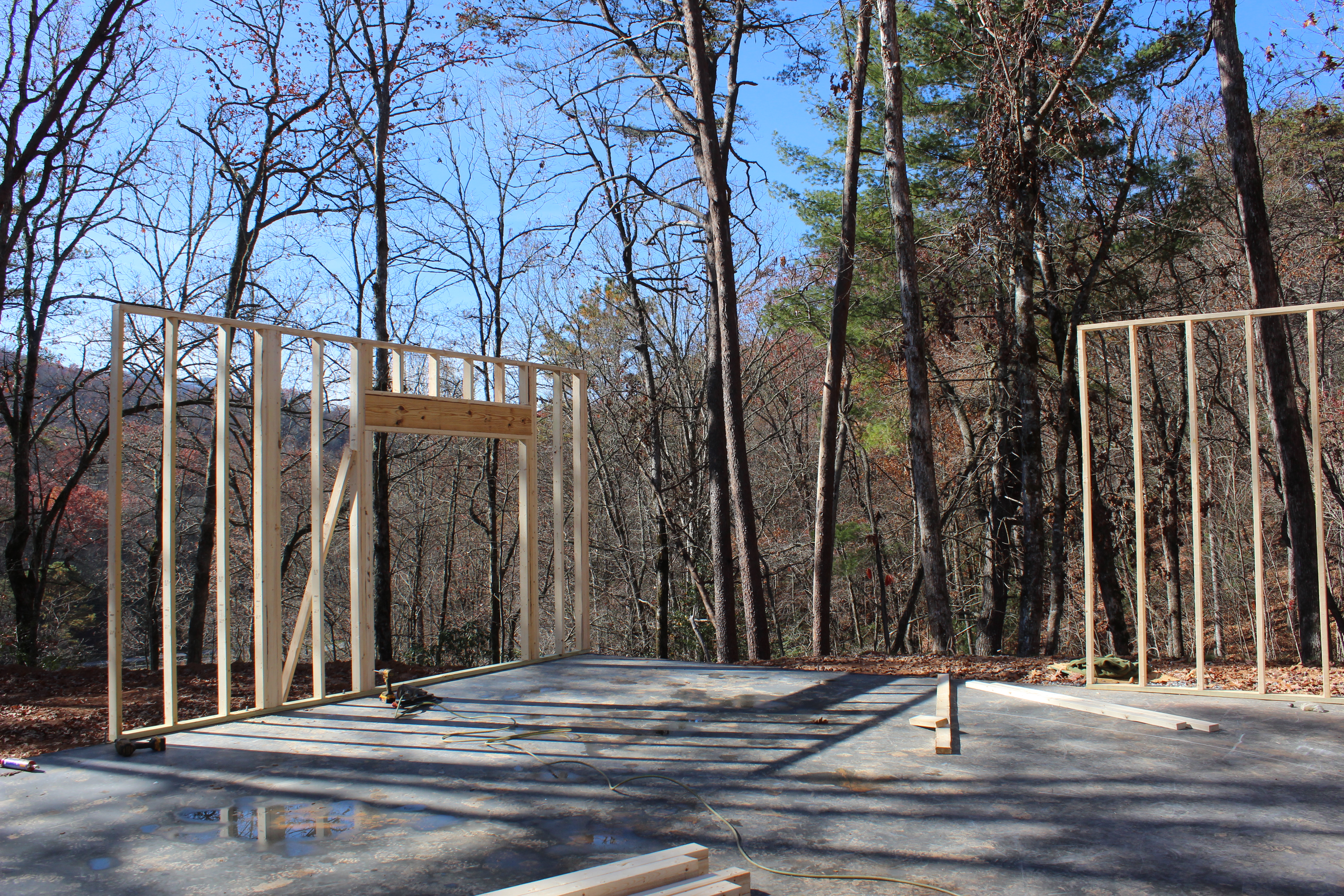
On Monday, Nov. 13, contractors had already started standing the walls at the location. Lumber laid in thick stacks on the ground and glass panes were set up around the perimeter to be turned into doors.
Drinkwater said the properties’ distance of roughly four miles from downtown Bryson City would be an asset, saying people could “easily get a ride,” even if they didn’t have transportation.
The idea between both of Drinkwater’s projects ultimately is to make sure there are affordable places to live so the county can keep growing.
“We’re trying to keep rent to an affordable price,” he said. “We’re not interested in HUD housing. We’re interested in working people.”
Housing problems in Swain
Tyler San Souci, owner of Slick Rock Builders, also said Swain County could be doing more to help with the affordable housing.
“Swain County is not putting one single cent away for that,” he said.
He added later that the Town of Bryson City is doing well at getting infrastructure in place, though a lack of zoning is a concern.
“Without zoning in this town, we’re going to have RV parks and parking lots filling the entire city limits without any opportunity to build any housing,” he said. “People don’t like regulations and zoning, but we need something.”
Buncombe County, where San Souci also builds housing, is also squeezed for good affordable housing options, but their government has programs to help subsidize renters and make housing a little less painful.
“The county gave us $1.3 million and subsidized 40% of the mortgage,” he said of one recent projects he’d been involved in there.
Slick Rock Builders is currently working on a project on Black Hill Road in Bryson City, which will have 14 to 20 townhomes that San Souci said would be “a semi-affordable product.” He said they would save money putting in town homes as opposed to only building single-family residences. He hopes to see more collaboration with government in the future.
“It’d be nice to have some sort of teamwork,” he said. “Get the county and city to work together. Even one or two homes a year. Treat it like Habitat for Humanity. Those guys just pluck along with whatever money they make.”
He said Swain’s issue was in part that it had no economic development department – County Manager Kevin King works on writing grants when needed, but San Souci said it might behoove the county to hire someone specifically for the role for housing needs.
King was unavailable for comment on the matter at press time.
Many of those looking for houses include working class people like teachers, who “unfortunately don’t have a great salary,” San Souci said. He said the issue was ultimately just too hard for people to break through, with costs too high.
“No builder can figure out how to build something affordable enough that people can afford,” he said.
He described one interaction in which someone had approached him to build a house for their family, but the price range he was looking for was simply not doable. “He said the highest he could do was $250,000, and I told him ‘you’re looking at at least $400,000.’”
San Souci said it was interesting to look at the trends in how the area has developed compared to nearby Franklin, which is doing much better now growth-wise than it was a few decades ago. In Swain, he said, he felt like things weren’t progressing that way.
“The money is out there in Franklin,” he said. “They have greenways, downtown is blowing up. Why can’t we have a greenway?”
Building up
Chris Green, president of Kituwah Builders, said the company has a few projects either completed or almost finished around Swain County.
One on Arlington Avenue has several houses completed with “three or four more” to be completed later. One of them is on the market now, he said.
Green said high interest rates have made it tough on everyone, as has a lack of subcontractors. “There’s not as many people in the blue-collar trades,” he said. “For subcontractors, there’s a smaller pool than there used to be.”
Part of the way Kituwah Builders is helping with that includes using less expensive materials, including using vinyl siding instead of smart siding, and an eight-foot ceiling instead of a nine-foot one.
Green said the company’s idea was to be “part of the solution, not part of the problem” and help lower-income people find housing.
“Swain County is a great place to live,” he said. “We do want to cater to people coming from out of town, but also to the people here, the people who’ve always lived in Swain County.”