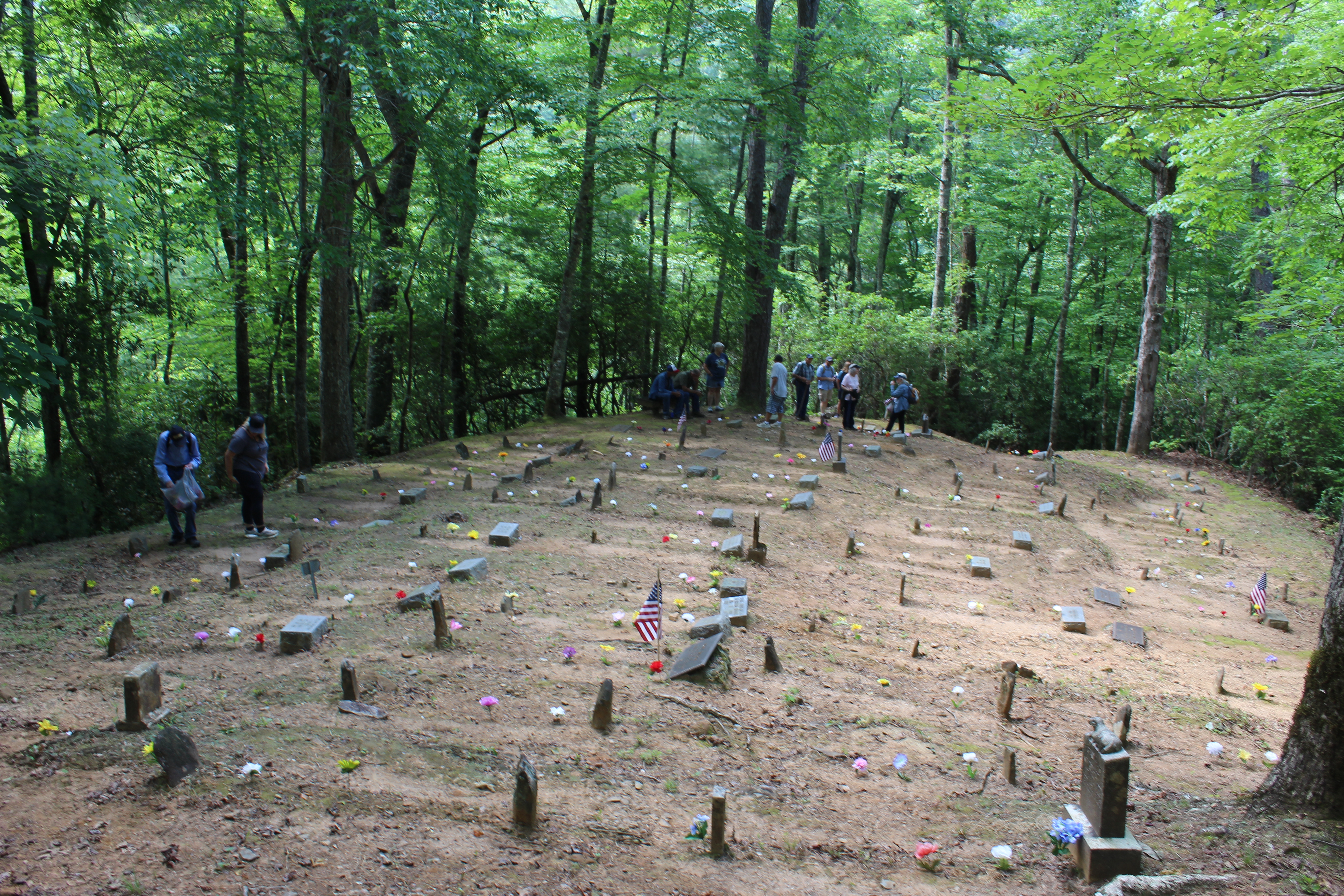
People gather to decorate the graves at Bone Valley Cemetery, one of several located on the North Shore of Fontana Lake.
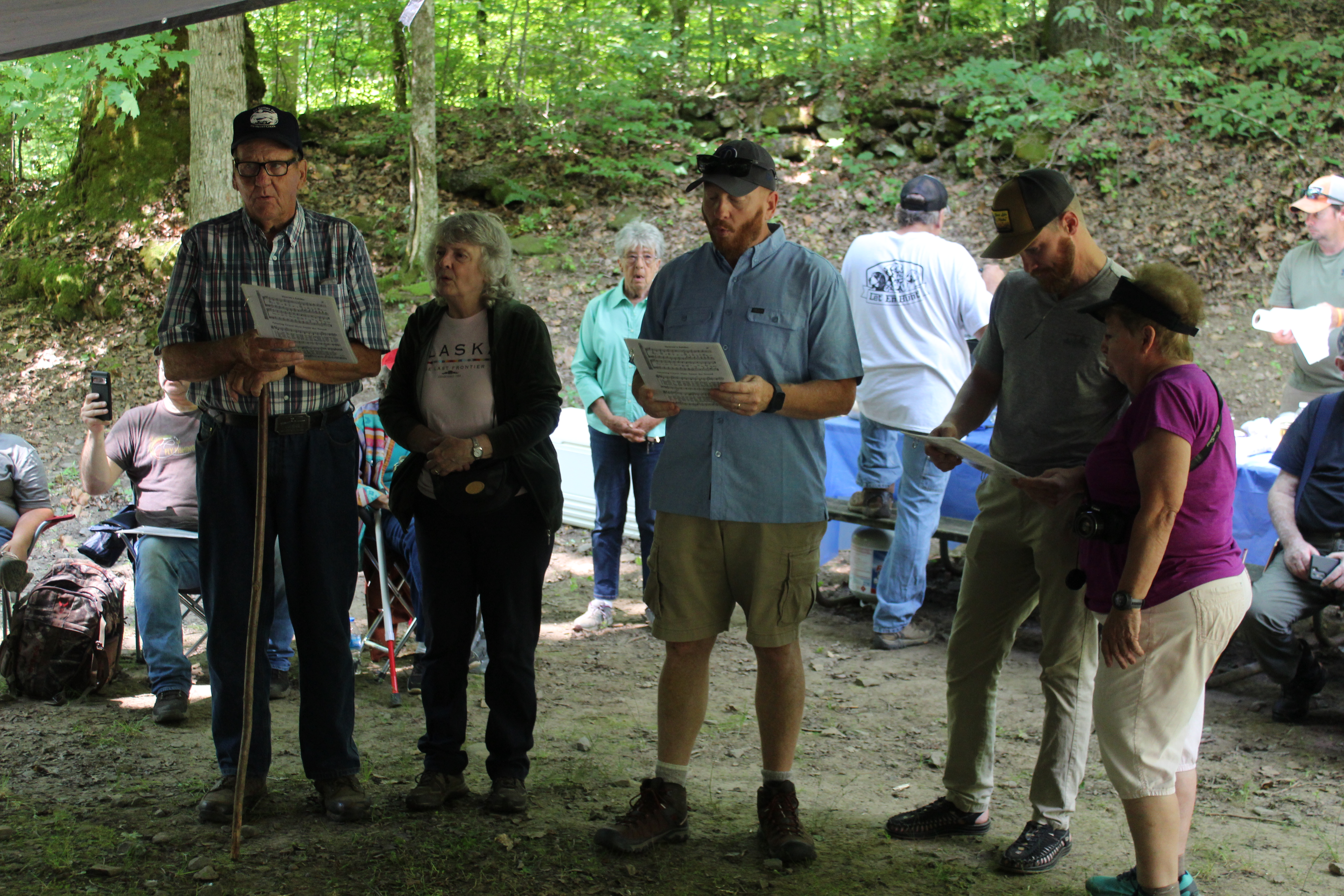
A group leads the singing of gospel songs before a service and the meal is served at the Bone Valley and Hall cemetery decoration day.
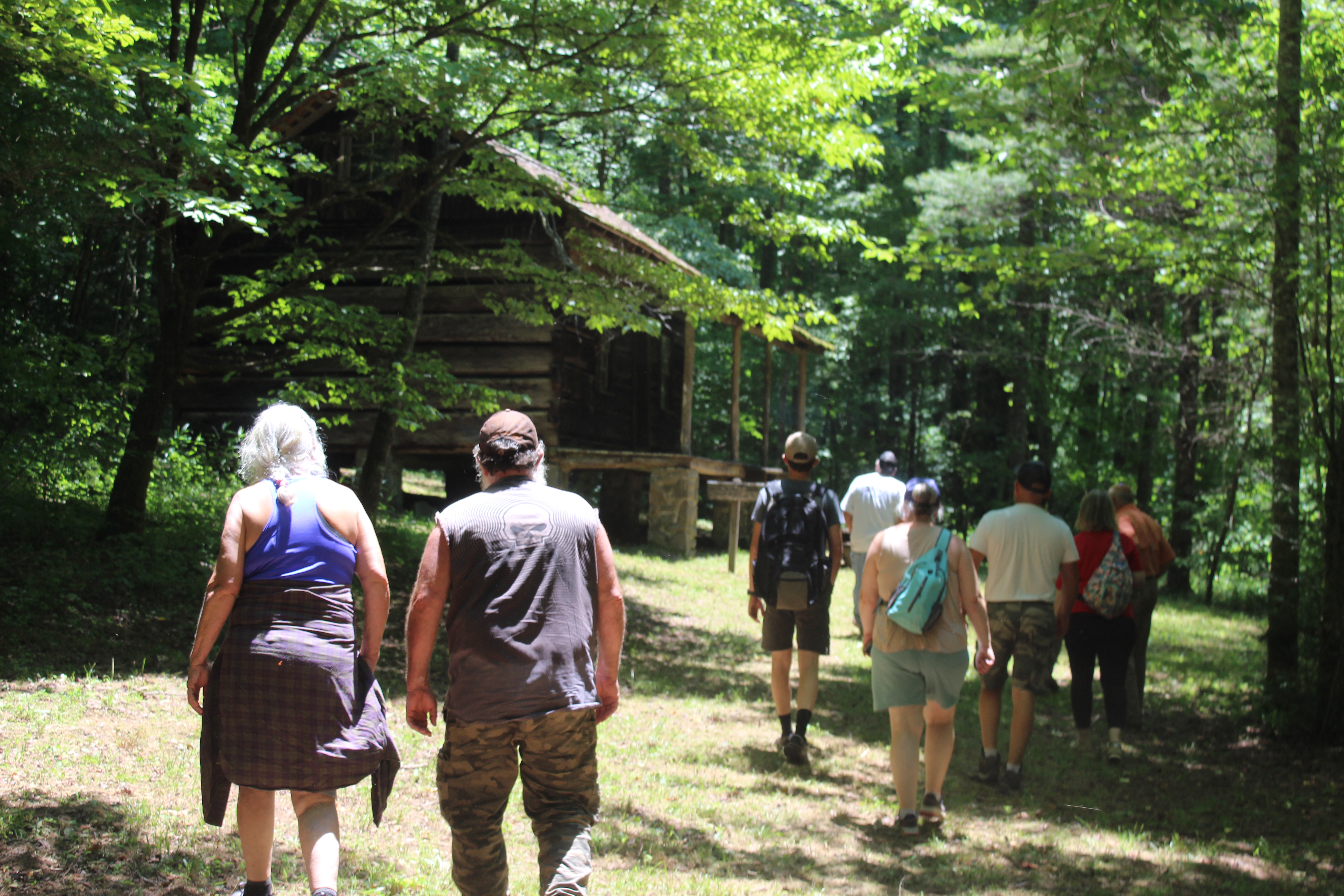
People walk up to see the Hall Cabin and learn about Kress Lodge that was located next to it before decorating Hall Cemetery.
Jessica Webb
editor@thesmokymountaintimes.com
Joining the trip to a North Shore Cemetery Decoration Day in the Great Smoky Mountains National Park is at once like attending a family reunion, hearing a history lesson, and taking a trek into the woods. You start early to line up to catch Miss Hazel from Cable Cove boat dock in Graham County to travel about 20 minutes across Fontana Lake to Hazel Creek.
This Sunday’s decoration is for Bone Valley and Hall, and about 87 people are attending. Before crossing the water, Henry Chambers with the North Shore Cemetery Association, addresses the crowd, asking for patience since the National Park Service provided just one boat that day instead of two despite the crowd. He then shares a bit of history about today’s destination.
How did Bone Valley get its name? In the early days of settlers to the area would pasture their livestock on the grassy balds and ridges. One year, most likely 1847, the cows were taken too early from Cades Cove and there was a blizzard.
“Instead of the cows going back down on the Cades Cove side seeking forage and shelter, they came down on this side, got to Bone Valley Creek, and the snow got too deep for them,” he said. “Afterward for years, you could go up there and find the bones.”
Family Connections
On the boat, you meet Don Burns, who has been coming to decorations since he was just a boy. Burns is a descendent of Orson Paul Burlingame, who was one of the first settlers to the area and worked as a surveyor for the Ritter Lumber Company when it came to Hazel Creek in 1907. Burlingame married Lily Brooks, and they had four children, including Don’s mother, Ruth Burlingame Burns.
“Burlingame was Ritter’s chief engineer and was highly educated. He fell in love with Lily Brooks, and they built a house on Hazel Creek beside her father George Brooks’ home with cherry wood paneling and running water. It was three stories,” Burns says. “The Park Service took it over, and they were forced to leave.
"They were paid $5,000 for the house and 55 acres, and the park burnt the house down.”
Ironically, Burns’ wife’s family was also relocated when Norris Lake in Tennessee was built for Alcoa. The couple lives in Maryville, Tennessee.
Don Burns gets choked up when he remembers those early trips to decorate the cemetery. His mother was up in her years and had trouble walking.
“We came up here and went across. They had a mule and wagon to haul Momma up the creek, and we had to walk. The next year, they had a hay truck for us to ride in, so that’s how we got started,” he says.
Today, about 20 of his family members are there including great-grandchildren. Among them is the youngest on today’s trip, a baby of four months.
The boat arrives at Proctor, and you ride up the mountain through Medlin and to Bone Valley. The gravel road once connected the North Shore to Old 288 in Bryson City, but much of that passage is now under water.
Park service, a moonshiner
You meet the National Park Service Fontana Lake and Trail Crew, Dakota Rogers, Brad Swartz “Cheesecake,” Trevor Lasick, Shawn Massey, affectionately called the “park boys” by Karen Marcus with the NSCA. Today, they will be your drivers as you climb into the open-air Polaris for an exciting six miles along the stunning creek.
On the way, Marcus points out the still-intact Calhoun House, remnants of the Ritter Lumber mill, and Struttin’ Street, where the houses of the mill management lived, as well as chimneys and other signs of where homes were located.
On the short, steep hike up to Bone Valley Cemetery, you meet Garmer Burchfield from Ellijay, Georgia. Garmer is a descendent of “Long Hair” Sam Burchfield, a notorious outlaw and moonshiner from Cades Cove. Lynn Burchfield, who was born in 1907, was Garmer’s mother. Both of his parents were born on Hazel Creek. Garmer keeps up with the tradition of making liquor and was even featured on Discovery Channel’s “Moonshiners.” His recipe for his “go, go” juice is 200 years old.
At Bone Valley Cemetery, the graves are laid closely together on a hill of earth. It’s decorated with silk flowers, and American flags mark the veterans. You notice the graves of at least six confederate soldiers and one World War I veterans. You also notice several infant graves and others who died in their youth. The names on the stones that have replaced the simple river rocks include Brooks, Cook, Hall, Wilson, Laney, Calhoun and Martin.
Lumber companies
You talk to James Calhoun, whose grandfather, John Buran Calhoun, settled on Calhoun Branch around 1868 and operated the first store at Wayside, Storehouse Branch. James’ family moved across the lake to Graham County in 1900.
James paints a picture of what Hazel Creek was like when it was settled. The area was first settled in the 1870s-1890s.
“In 1906, when the author Horace Kephart came here, he mapped it out, and there were a few families that lived on the creek, and they were mostly subsistent farmers,” Calhoun says.
Many settlers were at first drawn to the area to work in the copper mines and then were employed by the logging companies, beginning with smaller operations like Taylor and Crate. Then, “Ritter brought in the railroad, and it transformed the area,” he said.
The logging companies cut anything that was considered worth cutting, including American chestnuts, maples and walnuts, drastically impacting the landscape. When Ritter closed operations in 1928, it had manufactured about 200 million boards of lumber, the equivalent of 650,000 trees.
Singing and service
Back at the grounds, people are seated at picnic tables under a huge tarp. Marcus gets everyone’s attention for announcements, singing and the church service. Everyone joins in on the songs which include “I’ll Fly Away,” and “Amazing Grace.”
Then, a special meal of deep-fried trout and hush puppies, slaw and fresh watermelon is served, along with homemade desserts and other potluck dishes. In a way, the meal is an homage to Hazel Creek, which is a destination for trout fishermen.
The fish fry, prepared by Richard Fortner and Kevin Anthony, was made possible through community donations from Coopers Creek Trout Farm, Bryson City IGA, Big John’s Produce, Old 288 Bait and Tackle, Kyle Smith, Ken Anthony Woody and Ham Husky and Clampitt’s Old Store.
During lunch, you meet the two oldest people on the trip. Billy Laney, 82, says his grandfather lived right there on the hill and his Aunt Mildred and his Daddy were both born in Bone Valley. Billy himself was born on Sugarfork and was 2 ½ years old when they left. He points out where the Bone Valley Baptist Church was across the creek.
Carrie Laney, 94, is widow to Gene Laney, who was born on Sugarfork and had to move when he was 10 years old in 1944. He moved to Waynesville, and the two met at church and were married for 65 years and 5 months.
Up to a year ago, Laney walked to all of the cemeteries. With sadness in her voice, she says, “Now, I don’t walk to ‘em, I ride to the ones you can. This is the first time I didn’t go up to the cemetery here.”
Hall Cemetery
After lunch, some pile back into the vehicles to catch the boat, but others climb in to ride the additional 2 miles up to Hall Cemetery.
It’s a hair-raising ride, where you cross creeks about five times. Riding in the Polaris, you have to lift your feet up as water fills the floor.
Chambers points out areas where the understory is more open, an indication that it was once a cornfield.
Embarking from the vehicle, you come upon the most remote intact cabin, Hall. Chambers explains that Hall cabin was relocated to its present site by Samuel Henry Kress nearly 100 years ago. It originally stood across the branch where the Park vehicles turn around.
You brave a peek inside the small cabin, even though two people who came out report they saw a snake inside. Chambers draws people’s attention to the foundation about 100 feet beyond the Hall house, though, for what was once the Kress Lodge.
“The big thing then was to have hunting and fishing camps, so Kress had a 14-room lodge there,” Chambers says.
Kress had more than 200 five-and-dime stores across the South, and his buildings were known for elaborate artwork and design, Chambers said, which can be seen today at the Kress Emporium on Patton Avenue in downtown Asheville.
The only thing remaining of the lodge now is the foundation and the chimney. According to Chambers, it is thought hunters burned the lodge down after being caught by Park rangers for illegally hunting in the Park. The lodge had been used as backcountry quarters for rangers working nearby.
It’s about a quarter-mile walk up to Hall Cemetery, where there are just 18 graves that get decorated with new silk flowers.
Before the ride back to the boat, you meet Chad Hodges, who like you, is on his first NSCD trip. He accompanied his neighbor, Douglas, whose family was from Cable Cove.
“I like all the history, it shows you how times have changed over the years,” Hodges says. “I like to imagine what it was like.”
About the North Shore Cemetery Association Decorations
Today, the area of Hazel Creek is one of the more remote sections of the Great Smoky Mountains National Park accessed primarily by taking a boat across Fontana Lake. The area might see little human activity today, but it once had several thriving communities that are collectively known today as the North Shore.
The area was settled in the late 1800s. Families of the North Shore were forced to relocate when the Tennessee Valley Authority constructed Fontana Dam and the lake in 1944. While some of the buried, particularly of the communities that would end up underwater, were re-interred at Lauada Cemetery, others became nearly impossible to reach with the main road connecting them, 288, also flooded.
For decades, families had little way to visit the grave sites.
Established in 1977, the North Shore Cemetery Association spearheaded the revival of the tradition held by Appalachian families of decoration days, gathering to clean up the cemeteries and place flowers. The association also has services with singing and big potluck suppers.
They garnered a partnership with the Great Smoky Mountains National Park to transport people across Fontana Lake for decorations and up the mountain roadbeds and trails to the cemeteries. This was in line with the contractual agreements made in 1943 between the federal, state and county governments— a commitment to access to these areas.
The tradition continues today from April through November with dedicated days for each cemetery.
This year’s decoration to Bone Valley and Hall was held on Sunday, June 23.
The next decoration will be Cable Branch Sunday, Aug. 4. The first boat will leave Cable Cove at 9 a.m. and the last boat at 10 a.m.
The North Shore Reunion will be held at the Deep Creek Picnic Pavilion on Sunday, Sept. 15 from 10 a.m. -2 p.m.
For more information and scheduling, visit
https://www.facebook.com/NorthShoreCemeteryDecorations.