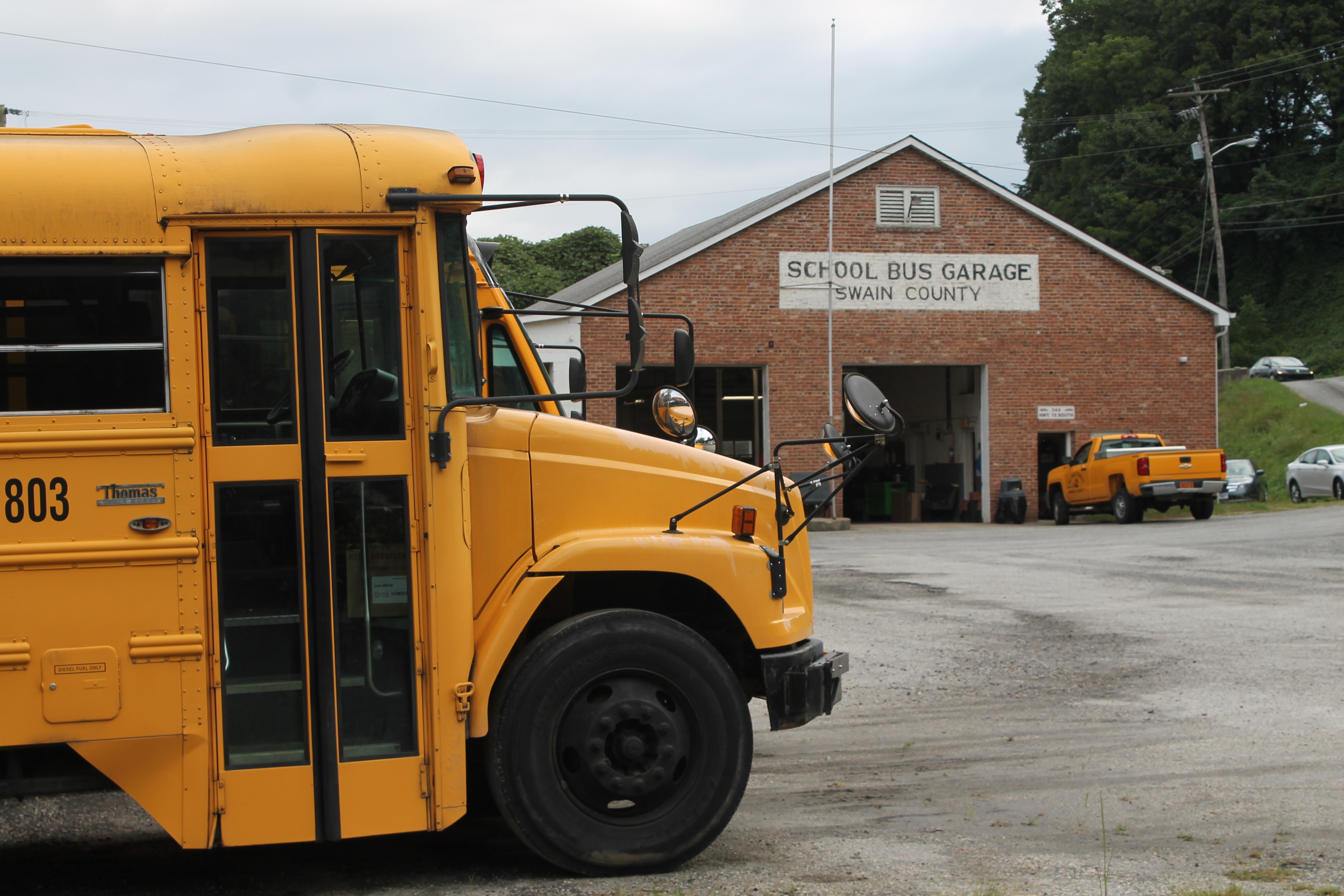
School buses at the bus garage
Jessica Webb
editor@thesmokymountaintimes.com
There are a lot of moving parts to making public school systems work and getting students to and from is among those pieces we rarely think about but depend heavily on. Behind the scenes, Swain County Schools has more than three bus drivers who have been with the district 20 years or more each, plus a dedicated bus garage staff. The pandemic, unsurprisingly, has put the stress on these wheels.
“We run 22 bus routes on a normal day, of course, nothing about this year has been normal,” explains Toby Burrell, transportation director. “For instance, today we’re running 17 routes. We have that many drivers in or out, some are sick. We’ve combined routes and brought in as many relief drivers as we have.”
Like school districts across the country, there’s a shortage of bus drivers. Some states have even turned to the National Guard to help. While the need isn’t as dire in Swain County, Burrell said he welcomes more applicants.
There is “quite a bit” of training involved that includes a driver’s exam to drive a bus, which is different than a CDL or other licenses. The district has its next training coming up in early October.
While some districts had to furlough drivers as schools were forced to close at the beginning of the pandemic last year, Swain’s yellow buses were still on the road delivering meals to students.
“It was a win in terms of keeping our drivers being able to drive and get paid—a lot of them depend upon that— and it benefitted our community, but it was exhausting work for our drivers to continue to do that every day. We were glad to get back into school,” Burrell said.
Drivers then had to adapt to A, B schedules, and required social distancing on buses and monitoring that students keep their masks on. While they are back to normal seating, the drivers do keep a seating chart of where kids sit in case the need for contact tracing arises.
Luckily, the pandemic hasn’t been the cause of a lot of drivers leaving the job, but the district still has a need for more. “We still desperately need drivers willing to take a full-time route and those willing to fill in,” he said. Afternoons, for some reason, are also when the need is higher.
For example, they had to fill 7 routes this past Thursday afternoon.
Recently, N.C. Association of Educators and Wake County school bus drivers held a demonstration to appeal to the state legislators to pass a state budget and include a raise from the average of $12.75 an hour.
While Burrell said Swain pays its drivers per route instead of per hour to help increase their earnings, “It’s still nowhere near as much as they deserve.”
The district is hopeful a bonus for drivers will come through to help attract more drivers.
With the drivers being the first and last person many students see in a day, they play an important role when it comes to student interaction.
“They are extremely important in that regard, Burrell said. “How they interact with our students, it’s invaluable, and our drivers do an exceptional job at that. We have a great driver pool who are dedicated professionals, and we’re grateful we have them.”
Many of the districts drivers stay on the job for years, if not decades.
The crew
A trip to the bus garage provides an insight into who is working behind the scenes to keep the yellow school buses and white activity buses on the road.
Robert “R.D.” Davis heads up the garage. “Our job here is basically to keep the buses in a safe condition for picking up and delivering kids,” he said.
As a parent, he knows how important that job is. They follow the state guidance for the buses, with every bus getting inspected every 30 days.
“We just make sure the buses meet the state regulations and are ready to roll and safe,” he said, adding, “The kids come first, it’s a safety factor.”
In the office, Tessa Crawford, TIMS coordinator, who Burrell called “miss everything,” somehow keeps track of all the working parts.
When asked about a normal day for her, she laughed.
“Normal days doesn’t exist right now,” Crawford said.
More often than not, they are short on drivers for the buses. Her days are filled with constant phone calls and emails. She even drives a bus sometimes.
“Yesterday, I had 11 drivers out— that’s more than half the staff!” she said.
“So, we’re grabbing anybody from central office, here, the schools to get them to drive. We’re getting the job done by the Grace of God for sure, but it is very exhausting right now and stressful.”
Kids are hilarious
Renee Evans has been a bus driver for Swain for more than 20 years. She’s like a bus mom to all her students. She said the job takes a lot of patience and is a big responsibility but connecting with the children has kept her going.
“I just love that they tell me about their life,” Evans said. “They are just so sweet, and then you get those that aren’t. We always think we can have bad days as adults, but the children have taught me that they have bad days too, and we sort of don’t allow them to. On my bus they get one bad a week, and then they are held responsible. Ain’t it funny how they teach us?”
While the pandemic has been challenging, she said it’s been most difficult for the support staff and that the drivers all pitch in “like a family” to make it work.
She agrees that sometimes drivers feel like they get forgotten and wages haven’t’ gone up like they should. The pandemic, too, has added to the stress.
“It’s been stressful I’m not going to lie I’m going to retire after this year it’s just been really 2 stressful years,” she said.
Bill Reynolds started as a bus driver when he was still a student in Macon County—and that was 34 years ago. “It was a pretty good little job then to have and take the bus home with you and take it to school,” he said. “I never thought I’d be in the school system 34 years later.”
He also teaches at Swain County High School.
“For me, it’s the students that keep me behind the wheel of the bus,” Reynolds said.
It’s certainly not the pay, he added.
“North Carolina has had a hard time for years and years, and our state politicians don’t seem to understand,” he said. “That’s why we have a shortage. If I didn’t work in the school system there’s no way I could afford to drive a school bus.”
Paula Brady has been driving a school bus for Swain County for 37 years. There are only three routes she hasn’t driven and it’s gotten to where now she’s driving the kids of her kids, as she says.
“I just love it all. I love the kids. I love the driving,” she said.
She tries to make a difference for the students, too. “Just telling them good morning will make their day and saying bye and have a good weekend. Enough of ‘em have a lot of negativity in their life, so they don’t need it here too.”
She hopes more younger adults will join the crew but agrees that it’s a challenging job and the wages need to increase.
“I’ve been here forever. I try to encourage the younger ones so they’ll stay because we don’t want them to leave,” Brady said.