
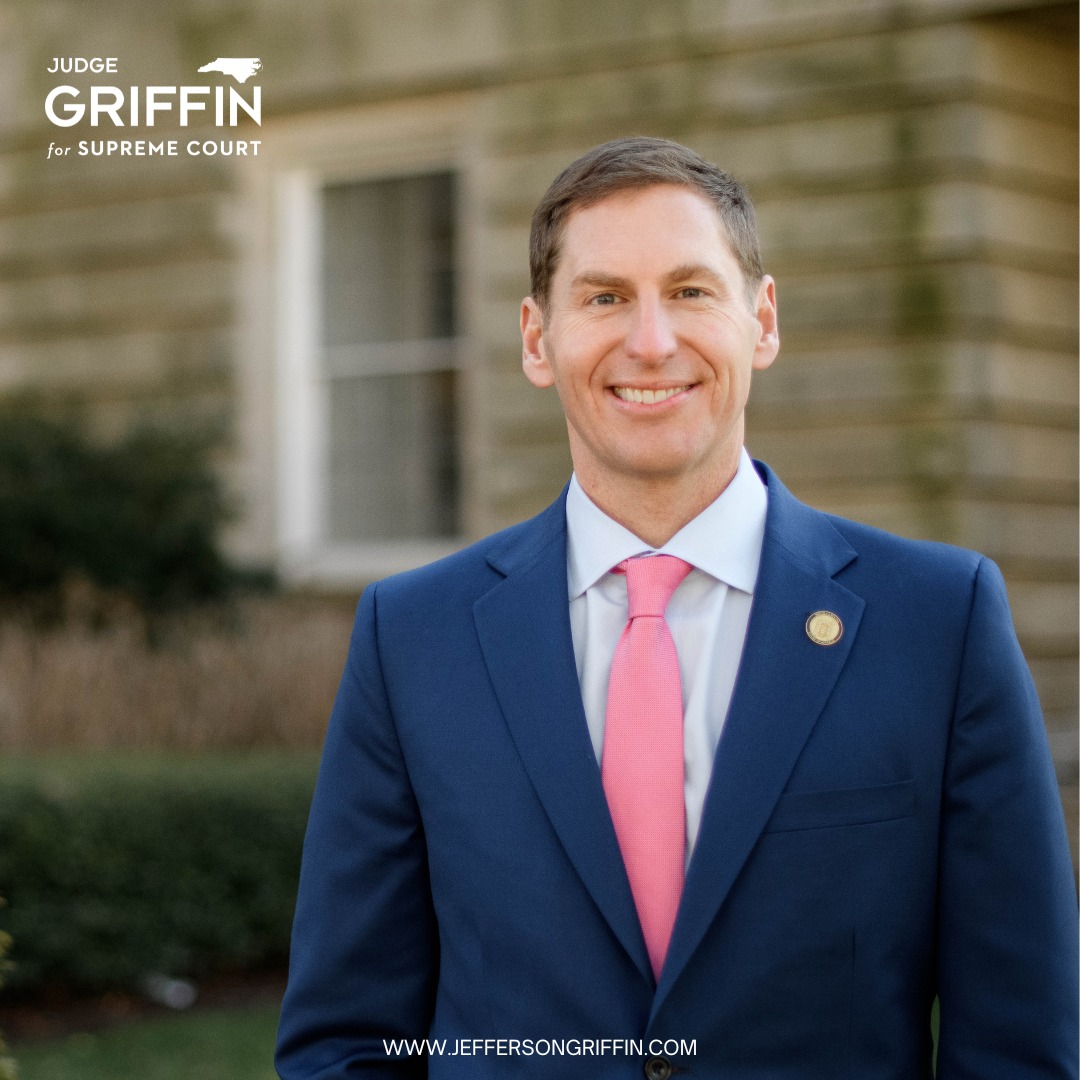
Republican NC Supreme Court candidate Jefferson G. Griffin has protested the eligibility of more than 60,000 North Carolina voters.
Jessica Webb
editor@thesmokymountaintimes.com
Swain County Board of Elections met Monday evening, Dec. 2, and held a hearing for an election protest filed by Republican candidate Jefferson G. Griffin, who has challenged voter status for more than 60,000 voters across the state seeking to disqualify ballots cast in the 2024 General Election. A little over an hour into the hearing, the board voted to dismiss the protest in a split 3-2 decision.
After a statewide machine recount of all ballots cast in contest for NC Supreme Court Associate Justice Seat 6, Griffin is behind Democratic candidate Allison Riggs by 734 votes out of more than 5.5 million cast. The difference was 625 when Griffin filed the protest Nov. 5.
Swain BOE was directed to handle the case challenging two Swain voters, Joseph Dale Bradburn and Joseph Wiley Lakey. The remaining challenges—nearly 200— against voters from Swain County are being handled by the state board of elections. No details for when the state board is planning a hearing have been released.
In the majority vote, the Swain County board determined Griffin had not met the full requirements of the law as outlined in 08 NCAC 02.0111, specifically about properly serving notice to all parties involved, with the board taking issue with how he informed the voters.
This followed a brief discussion as to whether they should be asking about whether the protest met the requirements of the law, since the state board ordered them to move into a hearing and forego a preliminary hearing. Board members John Herrin and Nannette Powell took a position that the state had decided such matters for them.
“Considering the state board absolved us of two of the four protests, I have to assume everything is just and correct,” Herrin said.
Powell agreed.
“If it wasn’t proper why would they ask us to go forward?” she posed.
Hannah Smith, chair, said the state’s order only confirms Griffin met the timeliness requirements and probable cause.
Kim Carpenter, Swain County attorney, took the same stance as Smith on the topic.
“It’s our job to make sure the other requirements are met,” Smith said.
She noted how the complaint provides evidence that the other candidate, Allison Riggs, was given a copy of the files, an affidavit shows election boards were served but lacks such evidence in regard to the voters.
“What we don’t have in this complaint is any information with regard to how this was served to the voters,” she said.
The voters named in the case were apparently mailed post cards that include a QR code and were advised they could also visit the NC State Board of Elections website, ncsbe.gov for more information.
“I’d argue all the filings were not served to these people with a direct stake; I have an affidavit saying that they sent a postcard,” she said. “I’d push back with voting rights being affected, a constitutionally protected right, I’d have followed the normal process for important legal matters and would have sent what the other candidate and board members got.”
She called the postcard and QR code unusual and inconsistent with notice of a complaint in any lawsuit.
Board member Jeramy Shuler agreed.
“I feel the same way,” he said. “I think the voters should have been served as much as everyone else. I don’t feel a post card is relevant in a judicial matter. We have no evidence they understand or have received this.”
Board member MaryK Buranosky said if they had the addressed, why didn’t they just send the voters the same documents?
Buranosky and Shuler joined Smith in the decision finding the protest does not comply with the requirements.
Following the decision, Smith said the question was whether they then proceed with the hearing to consider the substantive evidence of the case. The board agreed they didn’t need to move forward with that aspect after their decision.
Finally, the board voted 3-2 to dismiss the protest based on the protestor not meeting the requirements.
If the board had proceeded with evidence, the reasons for ineligibility before them were that Wiley, who had voted early, was deceased, and that Bradburn, who also voted early, had a verification returned undeliverable.
The bulk of the voters are being challenged on their voter registrations and for possibly not having provided driver’s license numbers or the last for digits of their Social Security numbers on their voter registration applications.
Adam Byrnes, Swain County BOE director, said in a phone call that he knows the protests say the voter registrations being protests are incomplete, but “that’s not consistent with the guidance we got from the state or with the law.”
Those on the list are welcome to contact the state BOE, he added.
If any of the protests were upheld by the local board or state, then they would have to retrieve those ballots and correct the results, he said.
Hand-to-eye recounts
Swain BOE held a sample hand-to-eye recount for the NC Supreme Court Associate Justice Seat 6 on Wednesday, Dec. 4 (after press time). Ballots from the Alarka precinct on Election Day were used for the sample recount.
All 100 county board of elections are also scheduled to conduct hand counts of ballots from randomly selected precincts and early voting sites in the statewide election for this race. Candidate Griffin requested the partial hand-to-eye recount, as he is entitled to under state law. According to the state board of elections, the sample hand-to-eye recount is designed to determine whether there are sufficient discrepancies from the machine recount to require a full hand-to-eye recount of all ballots cast in the contest.
An initial recount was conducted by machine, with teams at each county board of elections feeding all ballots cast in the election through tabulators.
State law provides that after the initial recount, the candidate with fewer votes may demand a hand recount in a random sample of Election Day precincts or early voting sites. Under state law, each of the 100 county boards of elections will conduct a hand-to-eye count of all ballots in 3% of its precincts, rounded up to the next whole number of precincts. Each early voting site is considered a precinct for the recount.
“The county boards of elections have worked and continue to work tirelessly throughout this election and the post-election period, including the recount process,” said Karen Brinson Bell, executive director of the State Board of Elections in a press release. “We cannot thank them enough for continuing to ensure voters’ voices are heard and that the results are accurate in the closest contests.”