
Jessica Webb
editor@thesmokymountaintimes.com
A bedsheet. A prisoner’s uniform. A basketball. Money. Toy figurines. So many baby and “flushable” wipes. These are a few of the unusual and unwelcome items Dale Wick with Environmental Inc., and Greg Passmore who operate the Town of Bryson City wastewater treatment plant, wish people would stop putting into the system.
“We desperately need a new facility,” said Passmore, of the plant that is located along the Tuckasegee River, down a gravel road surrounded by kudzu.
Between the two, Wick and Passmore have 41 years of experience in the field. The current plant is checked seven days a week, although it’s just required to be checked five days a week.
“It keeps us busy,” Passmore said.
“Screens is the most aggravating thing about this,” Passmore said of the plant. “When you have flooding, you just have to camp out there,” he said, next to the screens.
The town is in the design phase for a new treatment plant and the replacement of some of the sewer line that leads to the plant, with plans calling for a modern facility that will be able to treat twice as much as the current plant. The majority of the funding comes from a $15 million American Rescue Plan grant and an additional $500,000 from the revolving fund for Clean Water. The town will secure additional funding from loans.
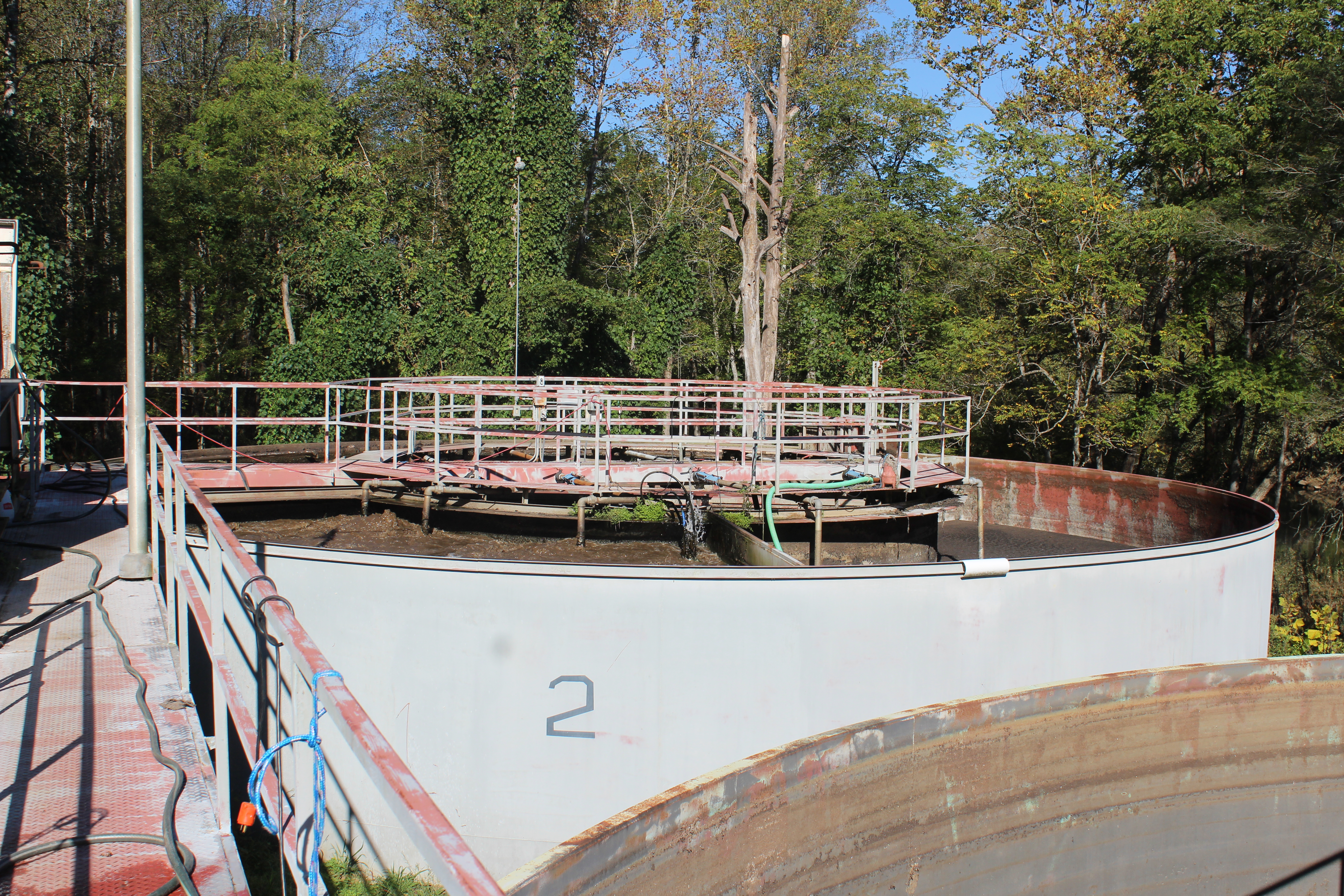
The initial side of the plant was finished in 1967 with the second side completed in 1981. It operates around the clock, so to say it’s showing its age is an understatement. The plant operators are often fixing things that break, and sometimes parts are impossible to replace. Walking up to the catwalk over the outdoor tanks takes careful footing, as hoses snake along the path. “A lot of things stop working, and we need to use pumps to move the water where it needs to be,” Wick explains.
The treatment process, contact stabilization, is no longer the standard. This plant is grandfathered in. Through this process, untreated water is mixed with aeration and undergoes a biological treatment.
“The concept of the contact stabilization is to treat more water… in the 1960s, that was the newest technology,” Wick said.
When water first reaches the plant, it goes through a pump and grinder before being piped up to the outdoor system that starts with two metal boxes and screens. Then, it goes into the aeration tank, clarifier, contact stabilization basin and the digester.
“It’s all a biological process,” Wick said. Aerobic bacteria, referred to as microscopic “bugs” consume the “food” or biological waste in the water.
“As it consumes it, it also multiplies. Occasionally, you have to get rid of the ‘bugs’ when you get too many,” Wick explains. How often depends on factors like the time of year and the flow.
“There’s a lot of variables,” he said.
The current plant is permitted for 600,000 gallons a day, with the flow dependent on things like the weather and population changes during the tourism season.
“We have a lot of I&I (inflow and infiltration,” Wick explains of the town’s wastewater collection system. This is when too much water gets into the system through old pipes, gutters and other means during rain events. This is another area the town has been addressing to improve its utilities.
Once the waste has been processed in the outdoor plant, the biosolids are fed through a dewatering belt press, which is indoors. It filters out the water and the final product is akin to dirt or fertilizer. The remaining water is filtered back through the system.
Before leaving the plant, the processed water goes through a disinfecting process before it is returned to the headwaters.
It’s not just solid objects like wipes Wick and Passmore say are bad for the plant. Things like floor strippers “can kill a plant.” Petroleum products and cooking grease are “terrible.” Some businesses, like breweries, are required to pre-treat their wastewater before it enters the system to protect the plant.
At the end of the day, Passmore said what he enjoys is “the science of it.”
The first and final message from the two plant operators, “We really need a new plant.”