
Court found Forest Service relied on flawed analysis
Jack Igelman
Carolina Public Press
Only three years into the completion of the Nantahala and Pisgah National Forest Land Management Plan, its future hangs in limbo, putting both current and future timber projects in Western North Carolina on pause.
A federal court ruled March 31 in favor of several conservation organizations, finding that the US Forest Service violated the Endangered Species Act in developing the forest plan by relying on a flawed biological analysis. As a result of that flawed analysis, the forest plan poses risks to four bats classified as federally endangered, the court found.
According to the Southern Environmental Law Center, or SELC, the ruling means that the plan finalized in February 2023 is void.
SELC staff attorney Spencer Scheidt called the ruling a “tremendous victory.”
“The forest plan process has been going on for more than a decade,” he said. “So it’s an immense relief to see the court agree that the process was flawed.”
Inadequate analysis
In July 2023, the SELC, representing MountainTrue, the Sierra Club, The Wilderness Society, Defenders of Wildlife and the Center for Biological Diversity, issued a 60-day Notice of Intent to Sue under the Endangered Species Act, contending that the Forest Service’s reliance on faulty and inadequate information, such as the ecological impact of climate change, places endangered wildlife at risk.
During the creation of the forest plan, the Forest Service asked the US Fish and Wildlife Service, or FWS, to consult on six bat species, including four endangered species and two species considered for federal protection.
Bat populations are in decline due to habitat loss and white-nose syndrome, a disease caused by a fungus responsible for killing millions of bats throughout North America.
The two federal agencies issued a “biological opinion,” or BiOP, which the SELC said was inadequate. A BiOP determines whether a federal agency’s proposed action is likely to jeopardize the continued existence of a listed species or damage critical habitat. It may also outline reasonable and prudent measures to minimize impacts to the species.
In September 2023, National Forests in North Carolina supervisor James Melonas wrote in response to the legal action that the Forest Service was “taking proactive steps to create a healthier, more diverse and more resilient forest, which can strengthen habitat for bats” countering the impact of white-nose syndrome.
The SELC ultimately filed a suit challenging the BiOP in April 2024, arguing that increases in timber harvesting in the national forest, among other stressors such as climate change and road development, would push bats toward extinction.
“Bats are key indicators of forest health and require large intact expanses of habitat to survive,” Scheidt said.
“Ultimately the assumptions and analysis of the forest plan wasn’t consistent with the agency’s approach, which was to increase logging goals and dramatically expand where logging could occur. The last thing these bats needed was someone to come up behind them and push them over the edge, which is exactly what this forest plan would have done.”
Arbitrary and capricious
The court’s decision ruled in favor of the SELC on five of eight claims. The ruling identified significant errors in the BiOP, stripping the 2023 forest plan of its legal authority, since it relied on the analysis to comply with the Endangered Species Act. The court ruled that the BiOP was “arbitrary and capricious,” a legal standard used by judges to review government decisions in which an agency acts unreasonably or without adequate explanation.
District Court Judge Martin Reidinger wrote in the decision that the BiOP must be vacated and required the FWS to address its flaws. “The Court recognizes the disruption to ongoing projects in the Forests, but the ESA’s directive to federal agencies could not be clearer: halt and reverse the trend towards species extinction, whatever the cost,” the judge said.
In response to several questions from CPP to the agency regarding the decision, a USDA Forest Service spokesperson wrote in an email that “the 2023 revised Nantahala and Pisgah Land Management Plan was developed over the course of a decade using the best available science and extensive input from experts, stakeholders and specialists across multiple disciplines. It focuses on the longterm health of Western North Carolina’s two national forests so that future generations continue to enjoy their recreational, ecological and economic benefits. The plan also prioritizes restoring and strengthening habitat for a wide range of wildlife and flora.”
The spokesperson said the agency is reviewing the court decision and committed to complying with all applicable laws and environmental regulations.
The agency has 60 days to appeal the decision.
Future timber projects
As a result of the decision, the Forest Service must ensure that all current and future timber projects are consistent with the previous 1994 forest plan until the BiOP and 2023 forest plan are revised.
Executive Director Lang Hornthal of EcoForesters, a nonprofit organization based in Asheville, told CPP that “now that a judge has decided what’s needed, proper remedies can be made and much needed forest restoration can continue to move forward.”
Currently, EcoForesters is working with the Forest Service, Wild South, Pisgah SORBA, the Riceville Fire Department and community members to come up with a sustainable plan for recreation and forest restoration in the Shope Creek watershed in Buncombe County, an area within the Pisgah National Forest heavily impacted by Helene.
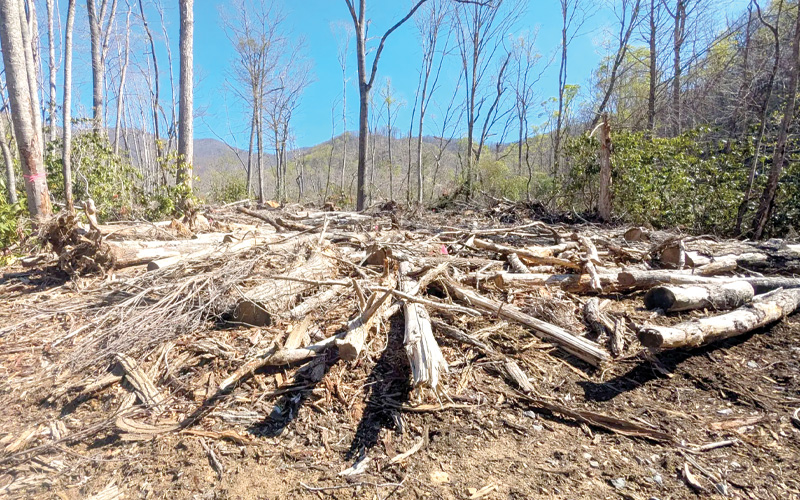
Amid widespread devastation along Shope Creek, dozens of newly planted white pine saplings, each roughly a foot tall, are rooting in small pockets between stumps and tangled limbs of trees toppled by wind. The Forest Service estimated that Helene caused moderate to catastrophic damage on nearly 200,000 acres of National Forest land.
“We’re all really busy trying to make sense of Helene’s impact, so there is no bandwidth whatsoever to think about a new planning process,” said Hornthal, who participated in the Nantahala Pisgah Partnership, a collaborative group of organizations that provided suggestions and guidance during the creation of the 2023 forest plan. The Partnership is currently inactive.
“Given all of the disturbance and challenges caused by Helene the last thing we need to do is to hit pause. If anything we need an acceleration.”
In the meantime, another legal challenge to timber cutting as envisioned by the forest plan hangs in the balance.
A lawsuit filed on March 28, 2025, by the SELC on behalf of four environmental organizations alleges that Hurricane Helene exposed critical flaws in the forest plan, which underestimates climate-driven storm impacts and promotes high levels of timber harvesting.
The Forest Service has filed a motion to dismiss the suit. The court hasn’t yet decided whether the case will proceed.
Whatever the court’s decision, Scheidt told CPP that “if the agency doesn’t go back to the drawing board and rewrite the plan as the court suggested, we are more than ready to continue fighting.”