
Noquisiyi Mound returned to Cherokee
Shelby Powell
reporter@thefranklinpress.com
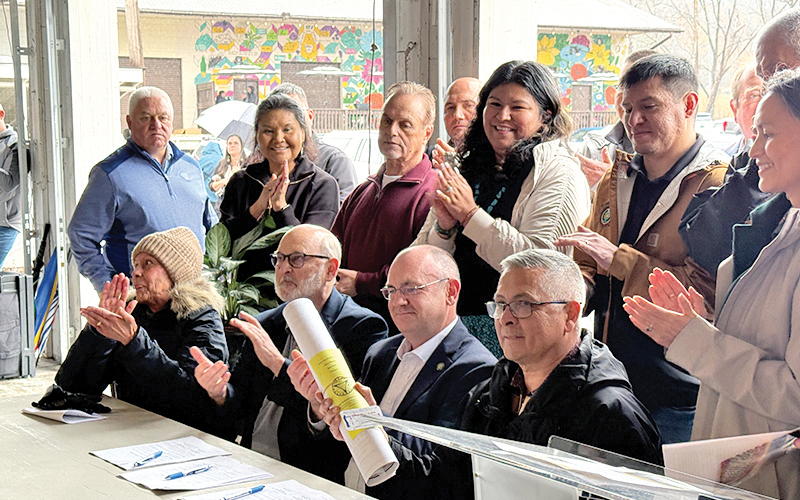
The Noquisiyi Mound was returned to the Eastern Band of Cherokee Indians on Feb. 26 in a signing ceremony attended by more than 100 Cherokee, local leaders and community members.
Background
The creation of Noquisiyi Mound is estimated to be approximately 1000 C.E. and it appears on maps in the 1500s. The land was stolen as Cherokee were forced from the land in the late 1810s and early 1820s. Further ethnic cleansing efforts from the United States resulted in the Trail of Tears in 1838, in which an estimated 4,000 Cherokee died as large numbers of people were marched westward.
The mound was passed between owners for the next century before being purchased by the Town of Franklin in 1946 with funds raised by community members, including school children, to purchase the property from owner Roy Carpenter on Oct. 7, 1946. The land was sold for $1,500.
In 2019 the land was transferred again from Franklin to the Noquisi Initiative, the nonprofit looking to preserve the site. On Jan. 5, 2026, the Franklin Town Council unanimously voted to return the mound to the Cherokee.
Signing ceremony
Thursday’s ceremony was officiated by Noquisi Initiative Director Elaine Eisenbraun. She wondered what it was like for the historical ancestors to the Cherokee responsible for building the mound, what they had been thinking about 1,000 years ago and what they may have imagined present-day residents would be thinking now. She invited visitors to imagine what we may be thinking in the next 1,000 years.
Roger Smoker led attendees in a prayer while Jarett Wildcat played flute.
Snowbird Tribal Representative Adam Wachacha said the mound serves as a potent symbol of the Cherokee and as a reminder of the people’s history and connection to the land, a “reminder that our history is deep and enduring.”
EBCI Vice Chief Alan B. Ensley spoke about being involved in a 1995 effort to have the land returned. He said the Cherokee understand how important these cultural symbols and artifacts are for the tribe.
The signing was conducted by Noquisi Initiative Co-Chairs Juanita Wilson and Bob McCollum, Franklin Mayor Stacy Guffey and EBCI Principal Chief Michell Hicks.
McCollum said this act was not an event that is done for those who were present, but something that is done for the next generation. “We can’t change anything in history … but all of us have an ability to have an impact on what happens next,” he said. “Let’s keep building good history.”
Wilson said the signing was the “culmination of a lot of time” and “a lot of work,” and credited Barbara McRae, who passed away from cancer in 2021, for her contributions to maintenance of the property and the efforts to restore it to Cherokee ownership. McRae was involved in forming the Noquisi Initiative and served as a co-chair. Wilson is fighting cancer herself but said neither the rain nor chemotherapy could keep her from the signing.
Guffey spoke of a personal experience as a child seeing his family needing to sell farmland after his great-grandmother’s passing. The money would be gone soon but the land would never come back. He said the situation is not the same as that experienced by the Cherokee – which occurred on an entirely different scale and left a different wound – but said the point of the signing was not to secure the best possible economic impact for Franklin but simply to do the right thing. Guffey thanked the Franklin Town Council for the unanimous vote that made the event possible.
“We have to protect what truly defines us as a tribe, what truly defines us as a nation … today is about forging a partnership and seeing how it can work better,” Hicks said.
The mound and the town of Noquisiyi, “was an integral part of us, it was part of our daily lives … it was torn away from us,” Hicks said. “Those people were taken away from their homes.”
Remembering the Trail of Tears, he said, “We lost a third of our people.” Hicks said boarding schools alienated indigenous children from their heritage, culture and people, as an objective of federal policy was “to wash the savage out.”
Hicks said returning the mound was a small gesture, but an important one to build ties between EBCI and Franklin. He said neither he nor any other Cherokee may be able to find the words to say exactly what the return of the mound means to the Eastern Band, but each knows what it means in their hearts.
Following the signing a group of Cherokee women including Myrtle Driver, Carmaleta Montieth, Marie Junaluska, Joyce Dugan, Juanita Wilson, Onita Bush and Amber Allen sang a Cherokee Women’s Song. The Aniyvwiyahi Dancers Youth Group performed the Bear Dance and lead attendees in a Friendship Dance to culminate the ceremony.
Cherokee and Noquisi Initiative board member Nancy Taylor was unable to attend the event due to being across the country on a work assignment. She said the signing was “a monumental occasion for me personally and for the Cherokee people. It has been a long process to the get mound returned and … it’s just a fabulous celebration.”
Taylor suggested returning the mound in October 2024 at a Noquisi Initiative meeting, which started the process that resulted in the transfer.
“That mound is a sacred site and just very historically significant to the Cherokee people. The transfer, the righting the historical wrong, embraces the full circle of birth, growth, death and then now rebirth. It’s very significant,” she said. “The wrongdoings were the historical theft of land, broken treaties and systematic violent displacement … My family was removed, forcibly and violently removed, from our original homeland, sent to Oklahoma. My return back in 2020 is significant, and it all pieces together with the return of the mound. So for me it feels like a full circle has transpired.”
Taylor said, “Ultimately the return of the mound ensures that the Cherokee people can thrive on their own terms. My return and then the return of the homeland signifies the completion of the cycle.”
“This is a lifetime accomplishment for me and ultimately I just hope that I have honored my ancestors and that they’re proud of me,” Taylor said.