

Annette Saunooke Clapsaddle
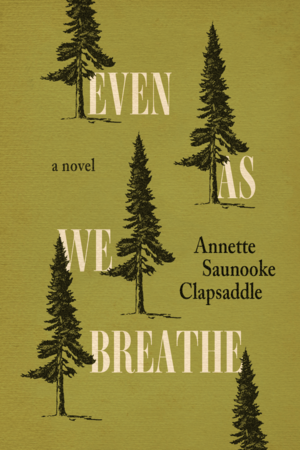
Swain County High School English and Cherokee Studies teacher Annette Saunooke Clapsaddle’s debut novel, “Even As We Breathe” will be released by Fireside Industries with the University Press of Kentucky in early fall 2020. This will be the first novel published by a member of the Eastern Band of Cherokee Indians by a major press.
With her first novel going to press this fall, Clapsaddle has been making a name for herself in literary circles over the past few years. Her first novel manuscript, “Going to Water” received The morning Star Award for Creative Writing from the Native American Literature Symposium and was a finalist for the PEN/Bellwether Prize for Socially Engaged Fiction.
“I’ve been a writer most of my life and played around with other forms of writing,” she said. She’s also had several essays published.
The path to publishing began with taking a course on completing a novel with Heather Newton at University of North Carolina Asheville’s Great Smokies writers program. Clapsaddle said the classes helped her get a jumpstart on the format and take a more organized approach.
“Even As We Breathe” tells the story of 19-year-old Cowney Sequoyah, who yearning to escape from his hometown of Cherokee takes a summer job at the posh Grove Park Inn and Resort. With World War II raging in Europe, the inn is the temporary home of Axis diplomats and their families who are being held as prisoners of war. Cowney soon finds himself accused of abduction and murder when the daughter of one of the residents goes missing.
Against the backdrop of opulence, Cowney comes to terms with issues of social, cultural and ethnic divides to which he must find freedom from and clear his name of the crime. Throughout the novel, Clapsaddle uses the elements of bone, blood and flesh to tell the story of American identity.
The setting
Setting the novel in historical Western North Carolina during one of the most tumultuous periods of modern history served as an ideal backdrop to explore the issue of citizenship.
“I became interested in the topic after I read an article in the Asheville Citizen-Times about the Grove Park Inn and the POWs who were housed there during WWII,” Clapsaddle explained.
“The themes of the book can carry into a contemporary period, but the setting was really important. Being at a point in our American history where there’s a microscope on citizenship and how it relates to identity, and race and social class, the WWII period really allowed me to talk about the things that I wanted to talk about.”
In researching for the novel, Clapsaddle discovered there is little written material about this unique point in the Grove Park Inn’s history. A book on the inn’s history provided a reference. Most of the research was more general about the period, such as the products available to consumers at the time, she said.
Clapsaddle said she wanted to set the novel’s main character, Cowney, in a completely different environment. On developing the character, she acknowledges pulling from her experience as a teacher for ideas.
“Cowney is a composite character. He’s not somebody that represents anyone I’ve ever known, but I teach high school and I’ve always had a soft heart for the teenage boy who is really smart in unconventional ways and trying to figure out what he wants to do in his life. I’m sure that comes into play,” Clapsaddle said. “He does the things teenage boys do. Try to figure out his love life and who his real friends are and how much forgiveness he’s willing to give to people. I hope that through his eyes, the readers are able to step into that world of the Grove Park with a different view of it maybe.”
Context
Some of the struggles that Cowney faces about deciding on his future and navigating are the same kind of challenges young people today might face.
“We can be isolated here in Cherokee, Bryson City and Swain County, and I think it can be difficult for young people who have not had exposure outside of here to adapt to new places with different kinds of diversity while staying true to their values, and that’s also a comment I wanted to make is how to balance your core values in a new setting,” Clapsaddle said.
The novel explores questions about humanity specifically about how Americans of different backgrounds are treated. She said one thing that interested her was learning that tribal land in the west was used as locations for Japanese American prison camps during WWII.
“It’s ironic. It’s sad. It’s so many things, to think about how one place speaks volumes to American ideas of citizenship and who gets to be a citizen and where,” Clapsaddle said. “That’s one thing I definitely held as I wrote, thinking about who’s a prisoner and who isn’t and how citizenship relates to our humanity. It’s very much about laws and definitions.”
“Even As We Breathe” invokes the elements of bone, blood, and flesh as Cowney navigates difficult social, cultural, and ethnic divides. The title, which originated from a line in the book that was later edited out, speaks to these themes.
“The book talks about these three motifs of bones, blood and skin throughout,” she said. “These are the things we use to determine citizenship, but the final takeaway is humanity is about our spirit and our last breath, and we know that, so that’s the concept I was working with.”
Editing
As a teacher, Clapsaddle has shared the experience of writing a novel and working to get it published with her students. “One of the things I’ve done over the last couple of years with my students is to keep them in the loop about the process I’m going through so they know it’s not just students who have to go through that process and they learn about rejection as well.”
Clapsaddle further developed her novel when she attended the Appalachian Writers Workshop at the Hindman Settlement School in eastern Kentucky the past 2 years.
“It’s one of the most authentic experiences I’ve ever encountered in terms of a writing workshop,” she said.
The experience is compelling both for the level of literary leadership and the community it builds.
“The time in between and after workshops talking with people; that’s just as valuable,” she said.
Such connections led to the Fireside Industries wanting to publish her debut novel. She was thrilled to learn that Silas House, a well-known Appalachian author and a friend would be her editor.
“To work with Silas House as an editor is an incredible experience,” she said. “Most people do not get to work with another author, let alone one with his abilities.”
On how she is able to write a novel while also being a high school English teacher and a mother and wife, Clapsaddle said she has to be super organized. Summers offer the time to outline the novel and for more extended writing, she said.
You can preorder copies through Amazon at: https://www.amazon.com/dp/1950564061/ or from your favorite local bookstore such as City Lights Bookstore at: https://www.citylightsnc.com/book/9781950564064
To hear more from Clapsaddle and editor House, you can visit www.facebook.com/Hindmanschool and watch a discussion the two had on Thursday, April 23.
You can also read an excerpt from “Even As We Breath” by visiting appalachianheritage.net.