
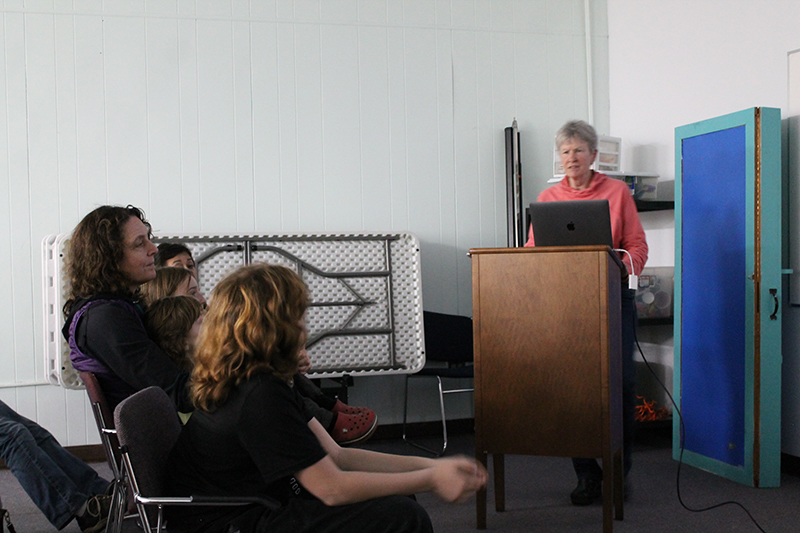
About 30 people attended a Climate Crisis Forum sponsored by Indivisible Swain held at the Marianna Black Library on Thursday, Jan. 30.
“A lot of people are climate deniers especially those running our nation,” began Joan Parks, who would go on to explore the science of climate change and paint the grim picture of its enormous impacts.
Nilofer Couture, who would present after her on the global investment in clean energy and shed some hope on the future, joined Parks. The two Jackson County Indivisible members gained climate reality training through Al Gore’s Climate Reality Project event in Atlanta.
First, Parks took a moment to clear up the difference between climate and weather.
Weather describes short-term atmospheric conditions while climate is the average weather pattern over a period of time, usually about 30 years, she said. In other words, just because it’s snowing doesn’t mean there’s no such thing as climate change.
With an image of earth up on the screen that was captured by Apollo in 1972, Parks asked, can we change? The answer: we must.
She then described the science of climate change.
“In reality, there is just a thin shell of atmosphere surrounding the planet,” she said. There are 110 million tons of manmade pollutants sent into the atmosphere every 24 hours contributing to global warming.”
“As radiation comes down from sun some infrared radiation is trapped into the earth, and as the CO2 concentration increases, more of the outgoing radiation is trapped,” she said.
Greenhouse gases are caused by human activity and the burning of fossil fuels. What are some of the biggest sources? Flying, oil production, forests burning, coal plants, coal mining and even the thawing of the permafrost.
Today, fossil fuels account for more than 98 percent of the world’s energy and the planet is warming faster than at any time in the last 60 million years. Global temperatures have increased exponentially—2016 was the hottest year on record and 2019 was almost as hot. In 2018, it was the 42nd consecutive year with global temperatures above the averages recorded in the 20th century.
Among locations recording the hottest temperatures on record were Melbourne, Australia at 121 degrees and Kuwait City at 124. “Birds fell from the sky from the heat,” Parks said.
Climate is tied to the weather patterns that shape the planet, and as climate changes, so too do the weather patterns. The world is already seeing stronger storms, bigger hurricanes and wildfires because of the changes. Hurricane Michael in 2018 third strongest storm ever recorded in the United States. Hurricane Irma spent 3 days in the same location in 2017 and set a new global record.
“The greatest effects of all attacks on the environment are suffered by the poorest,” Parks said.
Anyone who follows the news is familiar with the devastating effects of strong hurricanes and wildfires. As global temperatures continue to be driven higher by climate change, those impacts are projected to get worse with effects including climate refugees and even more who are at a water deficit.
“Climate change is a threat multiplier and driver of conflict,” she said.
The picture Parks painted in a world where the rate of carbon being sent into the atmosphere only continues to grow isn’t just grim it’s downright scary.
Technology gets better
It was then Couture’s turn to present. “The question we have to ask ourselves now is, is this a hopeless case or is something can be done about it?”
There actually is good news, she shared, in renewable energy.
“With every passing day solutions get more effective and affordable,” she said.
Solar and wind energy production is becoming more affordable and is being invested in more widely than previously anticipated.
“Even in the red state of Texas, we know there are some utilities that are offering free electricity at night because wind energy is so abundant,” Couture said. “In Germany more power was from renewable energy than coal in 2018. Wind is now Germany’s largest resource for energy.”
More investment is happening in solar as the cost of solar cells decreases, she added.
“In many countries where there is no universal electric grid consumers and businesses have leap frogged over the old technology and installed solar panels where they never had electricity before,” she said.
Companies too are making investments to make the switch to clean energy resources. Over 190 global companies have made a commitment to go 100 percent renewable. One example, Ikea in Atlanta installed solar panels on its roof that produces enough energy to prevent 1,000 tons of CO2 going into the atmosphere by the end of this year.
“Can we change? I think we can,” Couture said. “Will we change, yes, we have to.”
As the technology improves, the job market in green energy will also grow, she said. “Solar installer and wind turbine service technician are two of the fastest growing jobs,” she said.
She then drove home a message to consider climate change when you go to the ballot box.
“In 2015, every nation in the world agreed to the Paris Agreement to work together to achieve net zero greenhouse gas emissions by the mid-century,” she said. “It’s true President Donald Trump has said he would withdraw from the Paris accord but the U.S. cannot officially until the 1st day after the next presidential election.”
A discussion followed the presentation, with people sharing anecdotes of how they have taken steps in their lives to reduce their carbon footprints and ways they could get involved to continue to pressure political leaders to divest from fossil fuel.
For more information, visit www.climaterealityproject.org.