
Larry Griffin
lgriffin@thesmokymountaintimes.com
Nantahala Area SORBA Vice President Jack Summers likes the way mountain biking uplifts his soul.
“I noticed I’m a lot calmer and more relaxed after riding some,” he said. “If I don’t ride for three or four days, my wife suggests I go ride. It makes me an easier person to interact with.”
SORBA, which stands for Southern Off-Road Biking Association, has chapters in a dozen areas in the southern U.S., including in the states of Alabama, Florida, Georgia, Mississippi, North Carolina, South Carolina, and Tennessee. The Nantahala chapter is tasked with keeping up various trails in the area such as the Tsali trail.
“We like to get out in nature,” he said. “The health benefits are really high if you get out and exercise. I read something in NPR saying biking has mental health benefits. It’s true for us, we want to make things where people are able to get out and enjoy the benefits of the natural world.”
He added that it was good for community-building, too, as people “share knowledge of trails and meet people,” and there was a “social aspect” to biking and being part of SORBA.
“It brings a sense of calmness to make life more pleasant,” he said. “We should all make time for that.”
It’s also why SORBA is trying to advocate for the creation of new trails.
They’re in favor of a new trail in Pinnacle Park in Jackson County, which Summers said is still being hashed out between the local governments of both that county and the Eastern Band of the Cherokee Indian, as the park borders their territory. “The Eastern Band recently elected a new principal chief and tribal council, so it’s not clear what they’ll do.”
He said the tribe had “been supportive in the past,” though, and so he had some hope.
Peter Tay, president of the local SORBA chapter, said SORBA wasn’t taking lead on that initiative. Rather, the Pinnacle Park Foundation based more closely in the area is in charge of that, but SORBA will help as needed with things like “trail maintenance, planning, and advertising,” Tay said by email.
On new trails around Swain, Summers said he hasn’t heard of any proposals recently, and he thought the Tsali trail and others around the area were likely good enough for locals.
“You’ve got to have the support of the community,” he said. “I’m not sure how many people in Swain County are pushing for new trails.”
Getting the work done
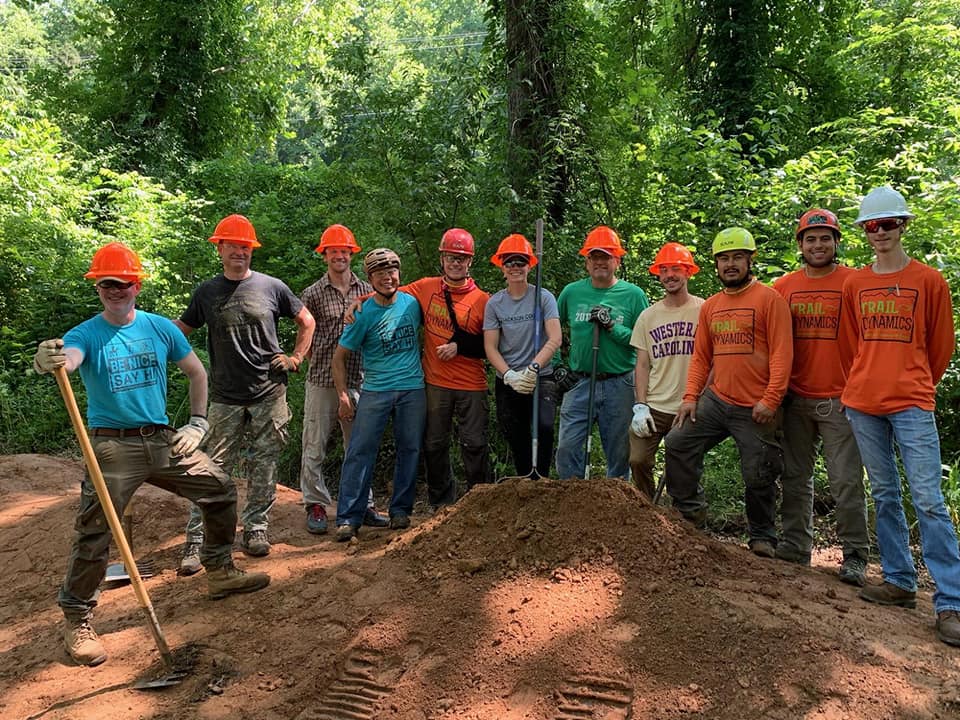
Otherwise, much of the work Nantahala SORBA does is upkeep on the Tsali trail, which is often used by bikers, horse riders and pedestrians hiking. They have specific days to go out and do things like cut back rhododendrons and shrubs, cut down fallen trees and work on trail drainage issues. Summers said that’s intended to “make things more sustainable for everybody.”
“If there’s a tree situation where it’s come down, somebody tells Peter and Peter runs out there with a chainsaw. He hikes 10 miles out there and cuts it down.”
Summers called the workdays a good opportunity for socializing. “I meet people I may not have otherwise met. I live in Cullowhee, it’s a bit of a drive, so I don’t usually meet a lot of people. Working side by side to clear the trail, you do meet people.”
They also do a year-end fundraiser, which happened this year on Monday, Dec. 4 and featured auction items including new bikes and other things, with the proceeds going toward SORBA work.
Treacherous paths
Mountain bike riding in the Smokies can be a somewhat treacherous experience. “It’s always challenging heading up hill. Going up, coming down, it requires a lot of attention, just so you don’t hurt yourself in the woods.”
Summers said it’s usually a good idea to pair up to ensure no one gets injured without any help around.
“If you go over the headboard and hit a rock, you’ll end up with bruises or broken bones and you’ll have to walk your bike out and go to the hospital,” he said. “The smart thing to do is ride with someone who knows you.”
Because the trail is shared between all kinds of people, including horse riders, Summers said there’s a consideration among SORBA members related to them, too, not just for bike riders.
“We keep it up for [the horseback-riding] community,” he said. “We maintain a good relation with them. We make sure to stay off the trail for horseback riders. The two things don’t really mix, and we want everyone safe and happy. We don’t want someone thrown from a horse, and we don’t want a horse to kick a biker.”
Asked if there was ever any friction between the groups, Summers said there had been, though nothing serious.
“There has been conflict, but we try to address our end of it,” he said.
Part of the conflict comes down to which groups or activities can use the trail on which days, which the National Park Service sets rules for. Summers said it worked out to know ahead of time which trail at Tsali they’ll be using on which days.
“We don’t want to come up on a pedestrian either,” he said. “Pedestrians probably don’t want to get run over.”
Hopes for the future
The board for the Nantahala SORBA meets once a month, but usually there aren’t a great deal of other members there. Summers said most of their other members just come out for the workdays or to ride.
He said there could possibly be more rides, however.
“I wish we’d organize more rides, more fun stuff and less work,” Summers said. “I think that’d help our engagement. We need to have a balance. We can’t have too much fun and no work, and we can’t have all work and no fun.”
He was unsure of how many members the club had currently active, though he said he wished there were more young people around working with the club – biking is less accessible now with the roads more populated by cars, so SORBA could be a good alternative.
“I’m 63,” he said. “I grew up doing it. That was a time when it was safer to bike on the roads. The roads are less safe now. We want to offer a way for young people to enjoy and have a good time.”