
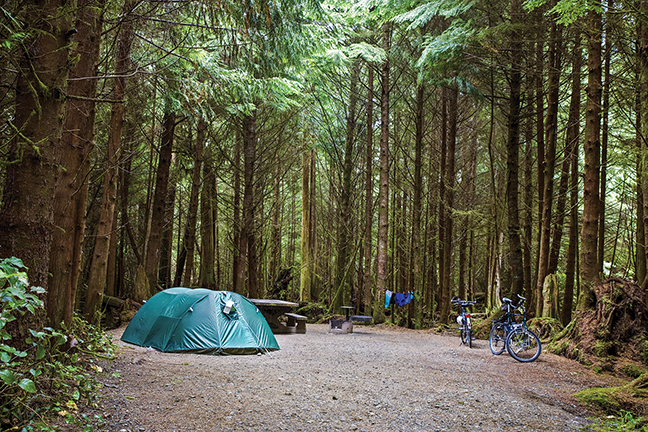
Center for Western Priorities released a report this fall titled “The Camping Crunch” showing that interest in camping has skyrocketed on public lands over the past 7 years. During the pandemic, as people sought out more socially distant ways to spend their free time, the interest grew even more.
There was estimated 39% increase in peak summer season of reservable campsite occupancy in the lower 48 from 2014 to 2020, according to the report on Westernpriorities.org. That’s a substantial increase compared to how just visits to national parks grew by 20%.
While there are potential benefits of this growth, there are also downsides including the potential for overcrowding and strained infrastructure.
The pandemic pushed even more people to seek the outdoors. The Outdoor Industry Association found 7.1 million more Americans hit the outdoors in 2020 than in 2019.
The report concludes a need for increased funding and investment in more public lands as the country adapts to greater demand for camping and outdoor recreation.
The study, based on data compiled from bookings on Recreation.gov, found an estimated 53% of campsite occupancy across the South in peak summer season. More than 95% were full on peak season weekends in 2019 and 2020.
In North Carolina, 56 camping facilities on the public lands database had an estimated 51% occupancy in summer 2020. Some of the sites in Great Smoky Mountains National Park had the greatest occupancy. Demand has also grown in the off-season.
In the Smokies
Brian Eversole, GSMNP supervisory fee and revenue specialist, concurred with the findings, and said demand has grown during the pandemic.
“Visitation to National Parks across the country, including the Smokies, has increased over the last year. People have a renewed interest in exploring outdoors as they look for ways to safely recreate,” he said. “Our most popular campgrounds remained full for most of the summer.”
All of the campgrounds in the Smokies are popular, he said. Elkmont, Cades Cove and Smokemont see the highest use.
With such a growth in demand, he stressed the importance of booking in advance. Group sites can be booked up to a year ahead and individual campsites can be reserved six months in advance.
With the increase in bookings, the National Park Service has bulked up its information for campers before they visit.
Infrastructure at many of the campgrounds are aging, he said, and it’s hard not to make improvements without impacting campers.
“When visitors have realistic expectation of what their experience will be like, they tend to have a more satisfying and fulfilling experience in the park,” he said.
Currently, the Park Service is updating the wastewater system at Elmont and Look Rock Campgrounds.
For people looking for a more challenging experience, the Smokies also has 103 backcountry campsites. Booking requires a permit that can be obtained by visiting at https://smokiespermits.nps.gov.
Nantahala, Pisgah
Camping in Western North Carolina’s Nantahala and Pisgah National Forests also followed the trend in growth. Based on data from recreation.gov, there were 8,039 reservations in 2014. For 2021 so far, there have been 40,131 reservations for the Pisgah/Nantahala National Forests.
For total visitation in the Pisgah and Nantahala, the United States Department of Agriculture Forest Service estimated 4,037,000 visitors in 2013 and 5,155,000 in 2018.
“Increased camping can lead to more people camping in areas that aren’t built for heavy camping use and causing resource damage as a result, more human waste that isn’t properly disposed of and more trash including cheap camping equipment left behind,” said Cathy Dowd, public affairs officer for USFS in North Carolina. “Additionally, with increased use comes increased operation/maintenance needs.”
To address the needs, the USFS has been educating the public about its impacts, Dowd said.
Some help has come from the Great American Outdoors Act.
“We have received $8.7 million so far, with more on the way, that we’ll be investing in places like the Davidson River Campground to improve the infrastructure and reduce deferred maintenance,” Dowd said of the fund.
She suggests campers plan ahead and be flexible when it comes to camping on public lands. Popular sites should be booked a few months in advance, she said. For dispersed camping, there isn’t the need to book ahead but recognize that some areas might fill up on holidays and busy weekends, so have a back-up plan.
Tsali and Jackrabbit are among the popular campgrounds, as are Standing Indian, Cheoah Point, Black Mountain, Davidson River, Lake Powhatan and Carolina Hemlocks, according to Dowd.
She suggests contacting the Ranger’s District office to find out about other campgrounds if the popular sites are booked. “There are some places that aren’t as busy that might be a great experience for you,” she said.
Other camping tips she shared:
• Bring a first aid kit.
• Keep an eye on the weather.
• Arrive early so you can see your campsite and check for hazards like dead trees nearby.
• Never leave your campfire unattended.
#Plan Like a Park Ranger (Plan Your Vacation Like a Park Ranger (U.S. National Park Service) (nps.gov). By following these tips, campers will be well prepared for a wonderful experience in one of the most special places on earth.
Reduce your impact & be bear smart:
•www.fs.usda.gov/visit/know-before-you-go/camping
lnt.org
•www.recreateresponsibly.org
•bearwise.org