
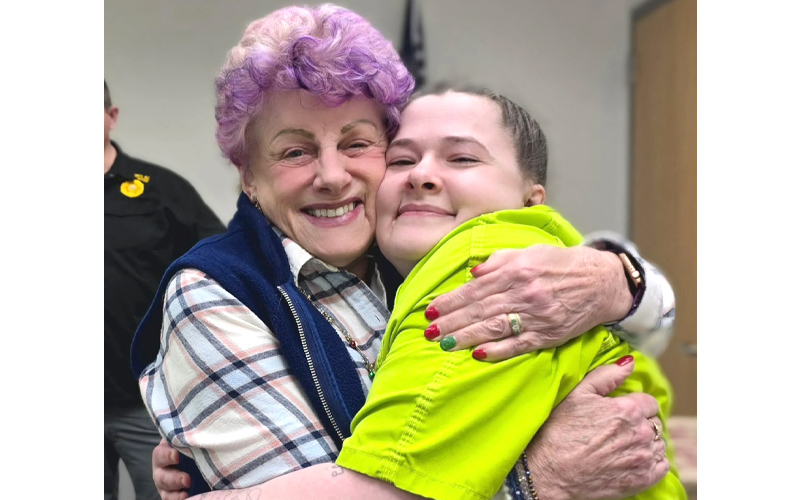
Kaye McConnell of Bryson City is a recovery coach in North Carolina who carries a heart larger than the New Year’s Eve ball at Times Square; it bleeds maroon and can be heard beating throughout the county.
For years, McConnell has collaborated with various community organizations and leaders, headed numerous initiatives aimed at improvement and has been known to present her many causes at county commissioners’ meetings.
McConnell’s New Year’s wish is to help decrease area substance abuse, emphasizing alcohol and marijuana misuse.
“Fifty-five percent of adults in Swain County report that their lives have been negatively affected by drug use,” said McConnell, citing data obtained from WNC Health Network.
Her hopes for Swain accompany a plan of action.
“I would like to see drug prevention education in all schools, K-12, as required by NC state statute 115C-81.20,” McConnell said. “There are many evidenced based curriculums that are being used in counties across NC, funded by ABC foundations. The funds for this education could come from Swain County ABC funds, $250,000, given to Swain County each year. It could be taught by two presenters who are well trained by the curriculum trainers. Providing our children with effective drug education and prevention programs will provide significant economic benefits, with studies showing a substantial return on investment. These benefits stem from primarily reduced healthcare costs, decreased criminal justice system expenses and increased productivity in the workplace. For every dollar invested in prevention, a return of anywhere from a few dollars to $65 in subsequent costs and benefits has been estimated.”
McConnell, a 1975 graduate of the University of South Florida with a master’s degree in counseling, is a former certified addiction professional in Florida. Over the years, she has served as a drug education coordinator, trainer and consultant, addiction counselor and prevention educator within the state.
“In 1985, I founded the Drug Prevention Resource Center and have since worked across all areas of the community, building strong partnerships,” McConnell said.
The organization, known as the Drug Awareness Center, continues to operate in Polk County, Florida, providing drug prevention services more than 40 years later.
In Swain County, McConnell has been deeply involved in community initiatives, including founding RENEW Bryson City, coordinating Community Drug Planning with Dr. Teeter, serving on the WNC Harm Reduction team, chairing committees for the WNC Recovery Alliance, holding board positions with Safe Kids Cherokee and Big Brothers Big Sisters of Swain County and much more. She also coordinates the WNC Seven County Drug Awareness Summit, teaches drug education at Mountain Discovery Charter School, mentors young readers at West Elementary, chairs the Youth Center Committee, organizes the Medicine Abuse Project Coalition for a Safe & Drug-Free Swain County, among countless other community service projects.
Looking ahead to 2026, McConnell hopes to continue driving meaningful change in drug recovery and prevention in the community she loves.
According to the recovery coach, alcohol is the most widely abused drug in the US, yet often left untreated. Meanwhile, the recent explosion of marijuana availability has placed youth and adults at risk, with addiction to cannabis having increased 78% in kids ages 12-17 over the past 10 years.
“There are 342 million people living in the USA,” McConnel added, referencing research obtained from Centers for Disease Control and Prevention. “Forty-eight million are addicted to at least one drug. Only 10 percent of those receive treatment. More than 70% of those who tried a drug before age 13, have an addiction.”
McConnell added that addiction to alcohol can be detrimental to a person’s physical, mental and social well-being.
“One in 10 Americans over the age of 12 have an alcohol use disorder,” she said, quoting American Addiction Centers. “Alcohol use is responsible for 178,000 deaths per year. Since one out of 10 people over the age of 12 have an alcohol addiction, you might be considering major changes in your life regarding your alcohol use. Think of the reasons that you might look for help.”
McConnell pointed out several negative effects of alcoholism to include its impact on families, often extending beyond the addicted individual to mold a “family disease with devastating consequences.”
“It erodes trust and love, leading to broken bonds, particularly affecting children who face increased risks of neglect, abuse and developing addiction themselves,” McConnell said. “Alcoholism also affects the workplace for the alcoholic and family members. Absenteeism is estimated to be four to eight times greater among alcoholics and alcohol abusers. Other family members of alcoholics also have greater rates of absenteeism.”
Alcoholism is a treatable disease. Therefore, McConnell asked that users consider the following:
• Do you feel the urge to drink when you know that you shouldn’t or didn’t plan to?
• When you try to stop or avoid alcohol, do you feel anxious, irritable or unable to focus?
• Do you find yourself drinking as a routine or pattern, even when there is no specific reason or benefit?
• Do you experience cravings that feel intense or physical?
• Do you frequently think about why, how or where you will drink next?
• Have you continued to drink even though it is causing problems in your health, work, family, relationships, finance or legal?
• Do you often feel regret, guilt, shame after drinking – but still return to drinking afterwards?
• Have you tried to stop, pause or cut back, but found it hard or impossible to do so?
• Do you sometimes use more than you planned or for longer than intended?
• Do you feel like alcohol controls you rather than you being in control?
McConnell added that AA meetings can play a crucial role in the recovery process.
“They provide a judgment-free space where individuals can openly discuss their struggles with alcohol addiction and find mutual support,” she said. “These meetings serve as a cornerstone for many seeking to change their lives for the better. The shared experiences of members help foster an environment of trust, making it easier to stay committed to the journey of recovery.”
If struggling with substance use, you can begin your road to recovery today by finding someone you know who participates in a program or find a program nearby for you to visit.
Call 1-800-681-2956 or 988-483-1289 or the Bryson City Presbyterian Church for more information 828-488-2480.