
Bryson City has received confirmation of two 2025 State Revolving Fund Supplemental Appropriations related to Hurricane Helene, said Bryson City Mayor Tom Sutton.
The town was awarded $4,998,000 for Wastewater Resiliency Improvements and $4,758,300 for Drinking Water Resiliency Improvements.
On Dec. 11, Gov. Josh Stein announced $270 million in funding to repair and strengthen the resiliency of water systems impacted by Hurricane Helene. The Department of Environmental Quality will distribute the funds to support 58 water, wastewater and septic system projects across Western North Carolina.
“Hurricane Helene laid bare North Carolina’s need to upgrade its water infrastructure,” said Stein in a release. “I applaud the Department of Environmental Quality’s quick work to award this funding faster than any other Helene-impacted state. Making these investments today makes us more resilient in the face of future disasters.”
According to Alderman Tim Hines, $4,998,000 in wastewater funding will support replacement and floodproofing of the Powell Lumber Pump Station and force main; conversion of the Lackey Hill Pump Station to submersible pumps with floodproofing; backup power improvements at all sewer pump stations except Carringer Street and Governor’s Island; and Supervisory Control and Data Acquisition (SCADA) upgrades at all sewer pump stations.
The $4,758,300 in drinking water funding will be used for the construction of a water system and emergency services communication tower on Winding Way; backup power at the water treatment plant and all major water system sites, SCADA upgrades to improve distribution system operations and data collection; SCADA floodproofing; and raw water intake improvements, including floodproofing panels and security enhancements.
While exact project timelines are not yet available, the construction of the Winding Way communication tower is expected to begin in the spring, with larger projects, including replacement of the Powell Lumber Pump, anticipated to start by the end of the year.
“The communications tower will be used by water system operations and emergency management,” said Nate Bowe, town engineer.
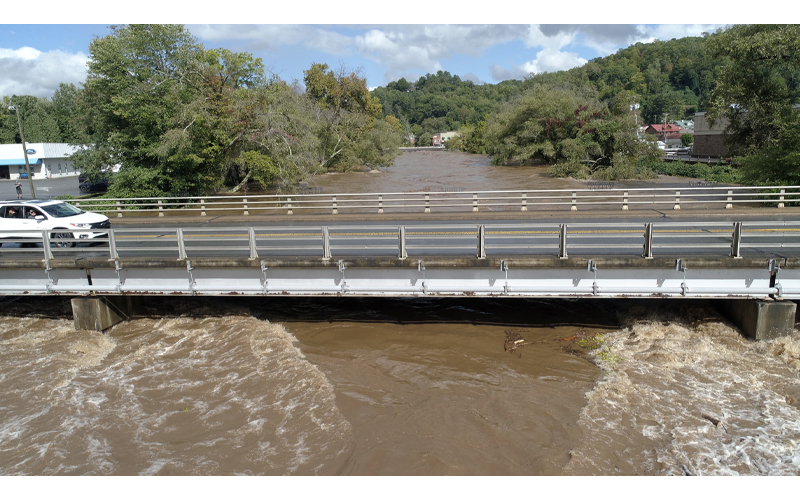
During Hurricane Helene, Bryson City lost radio and cellular service.
“I think the takeaway on this item is that the flooding of the town office during Helene damaged some of the town’s IT infrastructure, and the decision was made to relocate the bulk of our water system IT infrastructure to the fire department where it will be better protected from future flooding events,” Bowe said. “The installation of a backup power generator at the fire department is also included in the water resiliency project.”
Bowe added that town has been proactive with some of the measures included in the recently funded projects, most notably the relocation of IT infrastructure to the fire department and some SCADA and electrical improvements at various water system sites.
“The funding being received for these projects will go a long way toward reinforcing the town’s water and sewer systems against future natural disasters so that we have the ability to maintain quality services to our customers during and after such events,” said Bowe.
Regarding the proposed Swain County Middle School project, the replacement of the Powell Lumber pump station and force main will provide additional sewer capacity for the proposed school and other potential development north of the river.
“Bryson City is working with the Southwestern Commission on a grant application to the U.S. Economic Development Administration for a sizeable water storage and transmission project that will improve water system operations and fire flow availability, with the Dogwood Health Trust graciously offering to cover the Town’s grant match up to $2 million,” said Bowe.
However, if the projects Bowe discussed come to fruition, deficiencies could remain in the water distribution and sewer collection pipeline networks that serve the proposed middle school property.
“The town is coordinating with the school board and Swain County to identify and pursue available funding sources for improvements to the area,” said Bowe.
SRF Helene funding includes full principal forgiveness, meaning the town will not incur any additional debt. There is no repayment required by the proposed funding.
“In my experience, the SRF program doesn’t usually deal with grant dollars, but instead issues loans with some level of principal forgiveness,” said Bowe. “In the Helene Supplemental program, for the applicants (such as Bryson City) meeting certain criteria, the first $5 million of each project can be offered 100% principal forgiveness. This is what was approved for funding by SWIA (State Water Infrastructure Authority) at its Dec. 10 meeting. Our two incoming funding packages are not grants, but technically ‘loans’ that we do not have to repay because we are below the $5 million threshold for each project.”