
Larry Griffin
lgriffin@thesmokymountaintimes.com
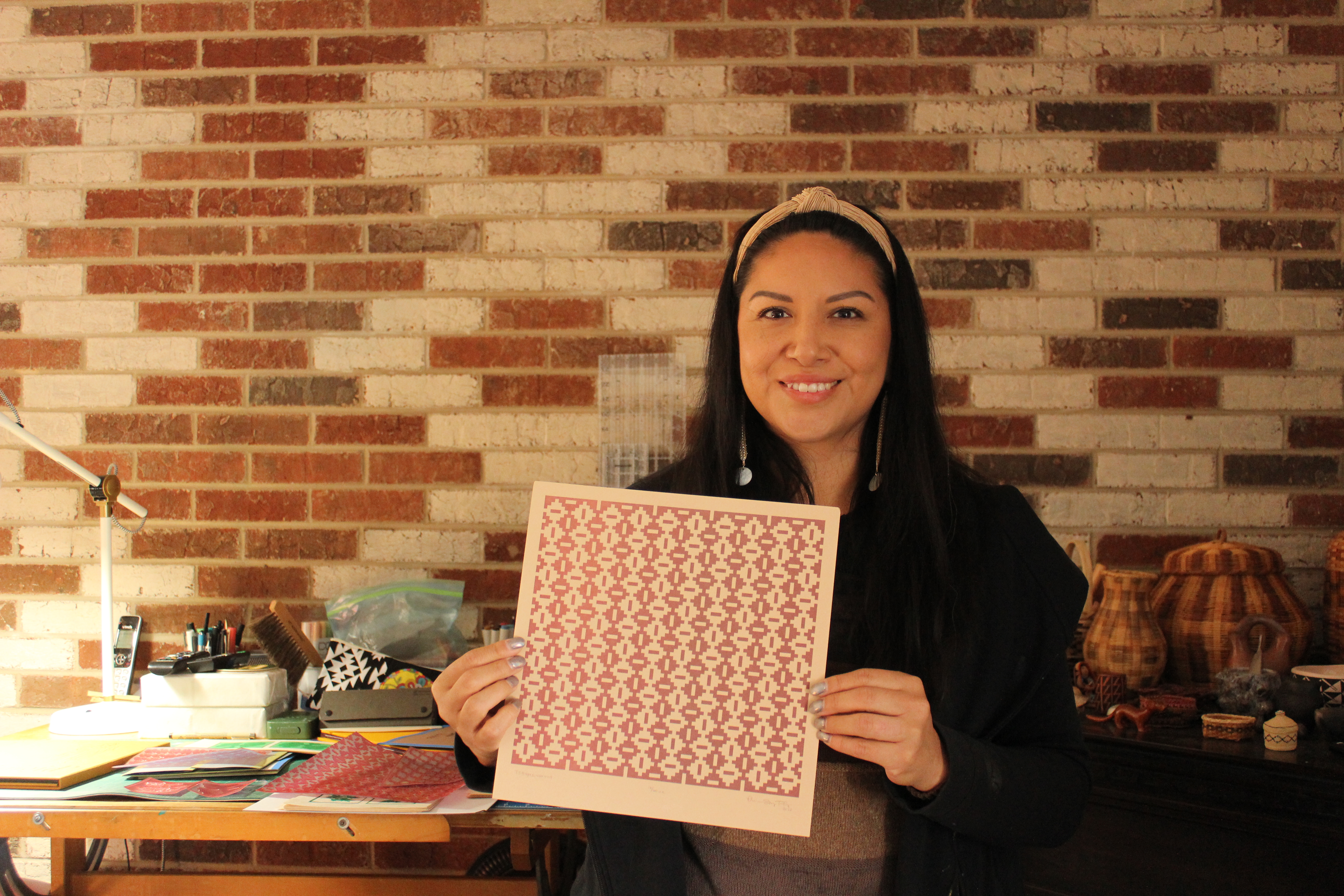
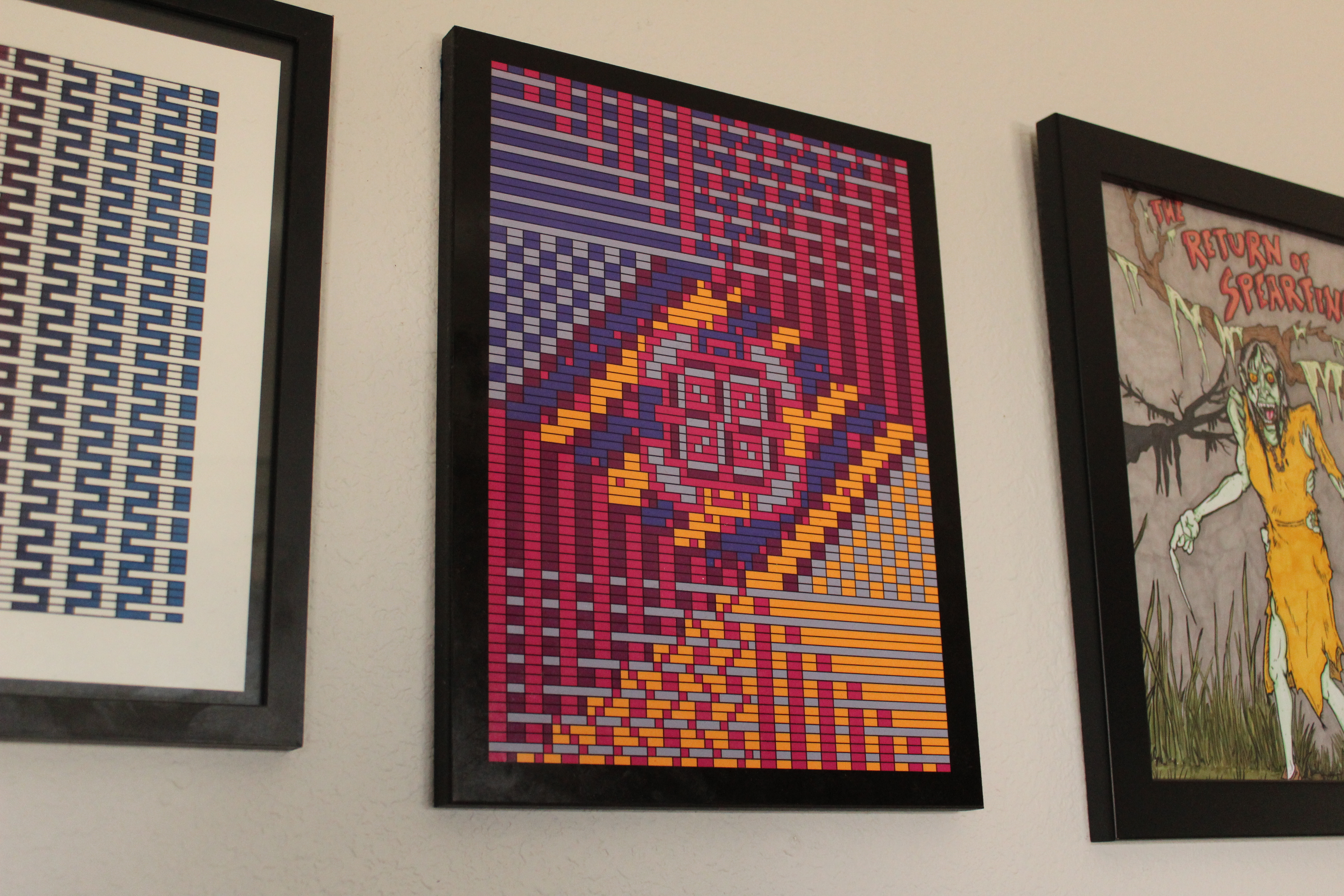
Skye Tafoya’s paper-weaved print art is made up of shapes and designs repeating in varying shades of color and texture. She hopes they will evoke her culture and personal memories.
The process of weaving the prints is a delicate one that Tafoya says she enjoys. “I really enjoyed the meticulousness. Everything has to be really precise. Everything has to be really clean. I enjoy the cleanliness.”
Tafoya, a native to the area despite moving around numerous times in the last few decades, resides these days in a home her aunt owned, nestled in the hills outside downtown Cherokee. Her uncle lives nearby and runs a horse-riding business, while her mother lives close as well.
Tafoya and her partner, Jakeli Swimmer, are raising a son, Otis, who just turned three years old. One piece hanging on the wall of her home reflects the feelings she had, a sunset-colored weaving, with shades of orange and magenta blending together in a mesmeric pattern. She said she wanted to evoke how she and her partner traded off looking after their son in his first months of being born.
“I took the nighttime and he took the morning time,” she said.
But never count an artist out. Tafoya said she adapted by learning to utilize digital modes of drawing “when I wasn’t holding a little baby.”
“I couldn’t hold him and cut paper and use tools at the same time,” she said.
Tafoya would be lying if she said she had no anxiety about being an artist right now. Art has never been a big money maker, and raising a child isn’t getting any cheaper these days.
“It’s scary to be an artist mom,” she said. “Being an artist doesn’t pay a lot. I have a lot of strains of revenue, but it took a long time to get there.”
She does artist residencies wherever she can get them, which fund her to travel solely for the purpose of doing art which she can then sell. Recently she completed one at the Women’s Studio Workshop in Rosendale, New York, and there are plenty of others she’s applied to recently.
Like any artist, she’s had to steel herself against not getting what she wants. “There’s a lot of rejection.”
The undercurrent to her work is family and community. “My granny died, and she was a basket maker from the tribe,” Tafoya said. “My work is about understanding the people I come from, highlighting how beautiful the things they’re making are.”
Pointing to some hand-woven baskets hanging on the wall of her home, she said her father and grandmother had made them and that she drew from similar wells of inspiration when crafting her own visual art.
“My grandmother’s baskets always inspire me, in the way my hands move,” she said.
The work is never ending. Tafoya said everything she does is always “slowly evolving into more things.” One of the pieces she’s most proud of is a “pop-up” book, which unfolds in a labyrinthine pattern full of golden-brown hues and rolls out squares of tan paper on which there’s an illustration and some poetry she did about her grandmother.
“I’m figuring out different pop-ups,” she said. “Opening them in different ways, figuring out what works best with what subject matter or the structure of the book, figuring out how people will react to it.”
One of her favorite designs is a patchwork slip weaving colored in reds and light tans, which mirrors the design of the bricks on the wall of her home.
She described the history of the house, originally owned by her aunt and then passing through several other owners. Tafoya remembered days long past in which the house was a hub of activity and gatherings of people.
“My aunt painted the bricks,” she said. “I took her thing and made it a little different. It’s representative of all the people who have been here. It’s supposed to look like eyes.”
The communal connection she wants to convey extends beyond the work alone. There’s one basket in her home that she’d found and is trying to locate who in the community it might have belonged to in years past. “I thought it was someone’s mother’s. It turned out it actually wasn’t. When I find out who’s it was, it’ll be going back to that family.”
Tafoya said she’s glad to be able to make a career from her art that draws on her heritage. But she’s always looking forward.
“I want to continue the legacy of basketing, and highlight that,” she said. “But there’s still so much more to learn.”