
ACA Hall of Famer celebrates 30 years, remembers NOC’s infancy
Sara Eisinger
sara@thesmokymountaintimes.com
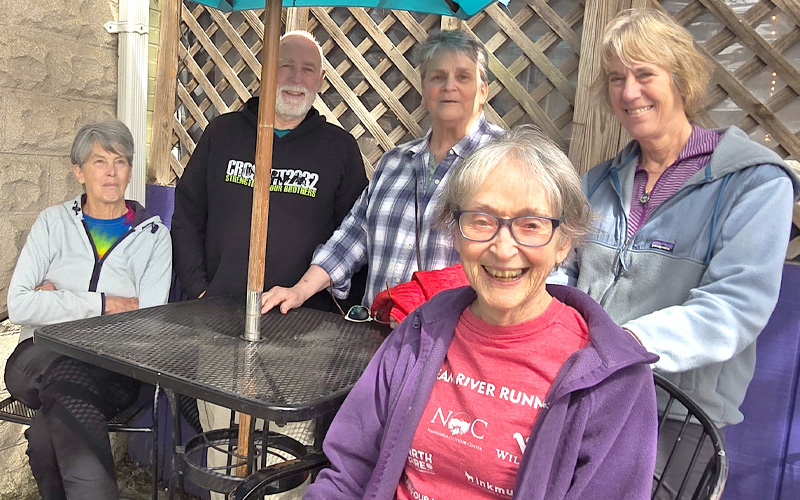
Five lifelong friends enjoyed coffee and brunch at Mountain Perks Espresso Bar & Café, reminiscing back to where and when it all began — Nantahala Outdoor Center in the 1970s.
Drew and Jude Hammond, Sherry Spurlin and Janet Smith each played integral roles in helping to launch one of the greatest leaders in outdoor adventure the country has ever known.
“NOC would not have been a destination without this group,” said Pam Pulley, owner of Mountain Perks.
Casually sitting in the center of the friend group was none other than original NOC lead paddling instructor Elizabeth “Bunny” Johns.
Bunny, 83, was inducted into the American Canoe Association Paddlesports Hall of Fame 30 years ago in 1995. She was later inducted into the International Whitewater Hall of Fame on Oct. 23, 2017.
Bunny was on the International Olympic Committee responsible for bringing the Summer Olympics to Atlanta in 1996. She even served as an Olympic official.
Bunny is a World Wildwater Champion, three-time Open Boat Nationals gold medalist, two-time Wildwater Nationals gold medalist and Open Canoe Nationals gold medalist.
Among her many outstanding accomplishments, Bunny has a PhD in Plant Physiology from North Carolina State University where she worked as a research associate.
Her story all began in the 1960s while working as a swimming instructor at Camp Merrie-Woode, a girl’s camp in the western hills. As part of the experience at camp, youth taught their counselors how to paddle.
“I was drawn to water,” Bunny said. “I was scared at first… the motion of putting the paddle in water. I practiced more and more, just focusing. I became enamored with the thought of controlling the canoe and making it move. For a long time, I paddled with an open canoe before moving on to deck boats and kayaking.”
In 1974, Bunny paddled her way down the Chattooga River to the heart of NOC where she met its founders, Payson and Aurelia Kennedy. Bunny instantly fell in love with the Bryson City paddling community.
“Horace Holden Sr. had bought the property on the river,” Payson Kennedy said. “My wife was a teacher and I worked at Georgia Tech. At the time, I had already decided to go into recreation. We worked for him that first summer. He asked Aurelia and I to manage it. We enjoyed it so much that we partnered with him and invested in the operation. We moved up here on the first of June in ’73.”
Bunny became one of NOC’s first staff members and fulfilled multiple roles. She started teaching paddling lessons in 1976. She wore many NOC hats from 1976 to 2000, having served as department head, vice president and president.
“I only wanted to help others have a safe, good time on the water,” Bunny said.
And she did. NOC’s whitewater paddling school became home to the country’s largest cadre of elite instructors during her reign.
According to the International Whitewater Hall of Fame, Bunny’s leadership in the development and dissemination of instructor certification and whitewater rescue forever shaped the standards of whitewater canoe and kayak paddling instruction. Those standards were adopted by the American Canoe Association in the early 1980s.
“She was in charge of the committee that developed the ACA training program,” Kennedy said.
Jude Hammond worked with Bunny, other NOC employees, sponsors and ACA to launch its first handicapped kayaks.
“Jude, here, worked with people with physical disabilities in schools,” Drew Hammond said. “She was a physical therapist. “NOC, at the time, didn’t have money to do what needed to be done with the program.”
Together, they supported the development of a kayak instruction program that catered specifically to paraplegics and amputees.
“I helped them all help me create the thing that was going to be the lifesaver to helping people get the instructions they needed,” Bunny said. “We enjoyed helping other people.”
NOC quickly rose to fame as the mecca for whitewater rafting, canoeing and kayaking.
“Several Olympians were part of the instruction program at NOC,” Drew Hammond said.
Mr. and Mrs. Hammond met while working at NOC in its infancy. They married on May 17, 1980.
“Where the NOC restaurant is sitting was once a staffroom (multifaceted room),” Drew Hammond said. “I was sitting there with three other men. I was 27 and there weren’t a lot of women around NOC… here comes this woman walking by the window, beautiful hair and a confident walk. We were all watching her. I did this double take because I couldn’t believe what I had seen. I said, ‘That is the woman I am going to marry.’ She was there with family. We were running a river trip and, here, she comes through the falls with her sister.”
He invited her to go rafting and she agreed.
Spurlin sat at the breakfast table, adjacent to the couple, giggling and remembering back when.
“That became the famous line — ‘Hey, you want to learn how to row?’” Spurlin said.
Spurlin worked at NOC as a guide, cook and shuttle driver in the 1970s.
“We all did everything,” she said. “We just wanted to be there and do whatever we could do to keep it going.”
Prior to her career with the NOC, Spurlin worked as a librarian at Georgia Institute of Technology.
“I went to the Chattooga River with friends where we met up with people from NOC,” she said. “They asked, ‘Why don’t you work for us?’ I never left… well, until I went off to the Olympics in 1996. I’ve worked four Olympic games and two Olympic FIFA (Fédération Internationale de Football Association) World Cup games.”
Janet Smith sat next to her close friend, Bunny.
“I taught for 20 years and came down for the summer from Michigan,” Smith said. “I signed on in ’85 and didn’t leave for 20 years. I worked as a switchboard operator.”
Smith helped NOC develop its winter travel adventure program.
“We started providing winter employment,” Kennedy said. “I led trips in Central American and Nepal. We had guys leading trips all around the world. Janet was in charge of that.”
Janet added that she coordinated the programs and ensured trip leaders had the resources they needed when traveling.
Kennedy was proud to say that many of his earliest employees went on to become doctors, business owners, lawyers, etc.
“So many extremely capable people worked here,” Kennedy said. “Most didn’t stay permanently because our salaries weren’t high enough. That first summer only grossed $45,000. No one had experience running a motel or gas station. We were all just learning, and it was a bit chaotic, but we tried to figure it out. I have great appreciation for them.”