
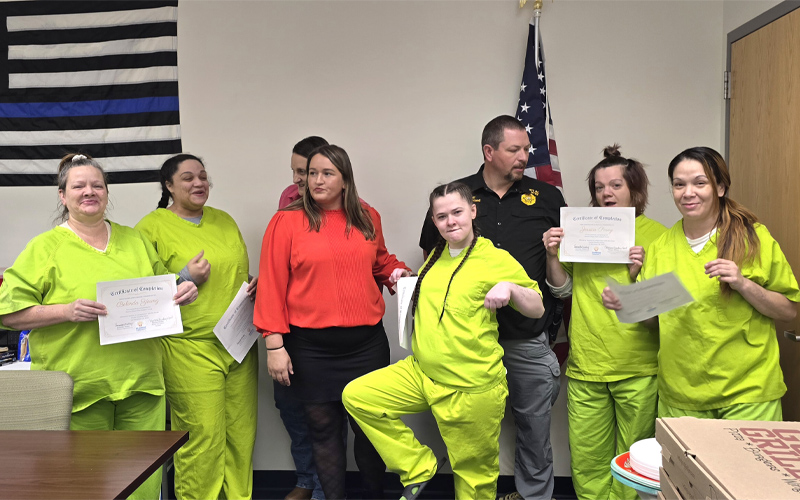
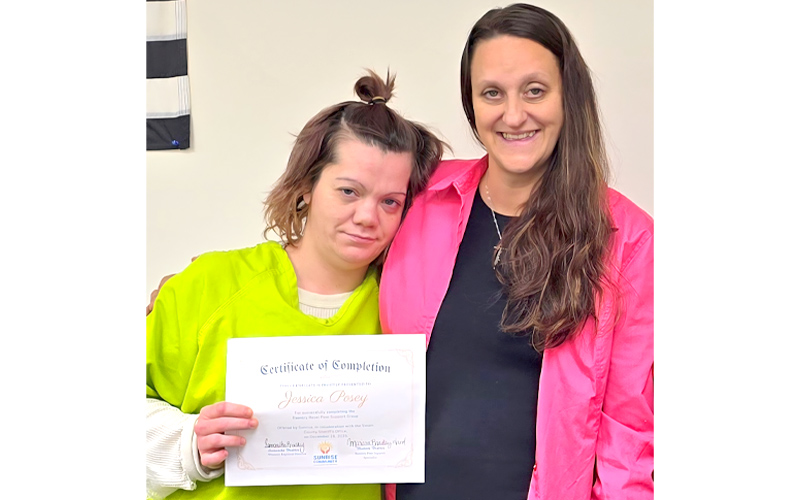
SMT photo/Sara Eisinger. Marissa Bradley-Ward stands alongside Sunrise certificate of completion holder Jessica Posey.
The day after Swain County Sheriff Brian Kirkland was sworn in on July 30, he reached out to former inmates to help reduce recidivism for drug-related offenses.
Now employees at Sunrise Community for Recovery and Wellness, Samantha Bradley, Western Region Director, and Marissa Bradley-Ward, peer support specialist, were once residents of Swain County Detention Center.
“I reached out to them because I had seen and been following their recovery work,” said Kirkland. “I met with them and thought this would be a good opportunity to make a difference in somebody’s life.”
Spanning across WNC, Sunrise provides a variety of free programs and services for individuals facing substance use and mental health challenges. Its wellness recovery action plan is being implemented in the jail.
Seven Swain County inmates—two males and five females—graduated from the Sunrise program Thursday. Classes began in October. Inmates met with their peer supports once a week, every other week for six weeks.
“I learned about a lot myself—drug rehab and stuff,” said Quinton Barker, inmate. “The importance in this is that there is no gap between parole and rehab.”
Once released, Barker will immediately enter a long-term rehabilitation facility.
“You could get re-exposed to different situations and old friends—with the stress of being out in the community again—those exposures are the things that connected me to substance use,” said Barker. “Sunrise connected me with the resources I would need straight out of jail.”
Two other Swain County inmates were recently accepted to long-term treatment, as well.
Barker added that the program has taught him to be more aware of his triggers and techniques to avoid patterns of substance abuse.
“In five years, I’ll be back in the community,” Barker said. “I want to start a rehab-thing myself. I want to help people.”
Barker’s Sunrise peer support specialist was Harold “Bumper” Smith.
“He’s been great,” said Barker. “It is hard when you’re on the inside, trying to get things done on the outside, and Sunrise helps with that.”
Sunrise documented 44,006 peer support interactions in 2024, alone.
Bradley has made it her life’s mission to ensure those interactions continue to positively thrive from Charlotte to Graham County.
“When I was in recovery for substance use and actually served time at this jail with Marissa,” said Bradley. “Unfortunately, they threw the book at her, and she had to do some prison time, whereas I got to go to treatment. There were not a lot of treatment options, and everyone had to go to Asheville.”
The year was 2016 and Bradley continued using substances to cope.
“I thought I would never have a career in anything because of the harm that I had caused,” Bradley said. “When I found out that I could use my story as my resume, it really changed things. When I learned what peer support was, I set that as my goal.”
Five years ago, Bradley joined Sunrise as a peer support specialist.
“I thought, ‘Wow, this is really cool, but we need this in the west,’” said Bradley. “One thing that separates us is we are not clinical based.”
Three years ago, Bradley’s dream came to fruition in the form of a re-entry program in Cherokee.
“Our ultimate goal is recidivism,” she said. “We want to stop seeing people come back through the system. Day-to-day for Samantha and Bumper looks like getting people to probation appointments, going to court with people and following up after, getting them to the store. While incarcerated, they are able to create the wellness recovery action plan, which is what we based the curriculum for Swain County Detention Center off of.”
The plan helps individuals when life becomes too stressful such as who to call and what resources are available.
“Someone was released yesterday and we pulled out her plan to see what she had written down,” said Bradley. “We have executed everything from what she had written, and we’re getting her to a safe place as planned.”
Inmates eligible to receive help through Sunrise while incarcerated at Swain County Detention Center include those experiencing substance abuse and mental health disorder.
“As long as they are willing to participate and can identify with the struggles we are presenting, they qualify,” said Bradley.
Since her own recovery, Bradley has wanted to give the community everything she was not.
“When people start receiving support—especially from peers and people who have been there—the whole jail morale can be better,” Bradley said. “This is the first opportunity we have had in the West to be in the dorms with people, which really makes a difference because it takes all the barriers out. Swain County and Sheriff Kirkland have really leaned into the peer support model, which is low-barrier and talking about real-life stuff. We can’t praise them enough for allowing us here.”
Since transitioning to peer leadership in 2016, Sunrise Community for Recovery and Wellness has become a cornerstone for individuals seeking recovery from substance use and mental health challenges across WNC.
According to its website, Sunrise offers a wide array of cost-free programs and services designed to support both individuals and the community. The Sunrise Recovery Community Center in Asheville provides a safe, non-judgmental space with peer support, support groups, basic needs assistance and community activities.
The Blair H. Clark Respite House, the first of its kind in the state, offers up to seven nights of 24/7 peer-supported respite as an alternative to non-emergency psychiatric hospitalization.
Other programs include a Medication Assisted Treatment program for justice-involved individuals, culturally aligned recovery centers on the Qualla Boundary, transitional recovery housing, harm reduction initiatives, employment and skill-building programs through the Foothills Recovery and Employment Ecosystem and specialized support for problem gambling. Additionally, Sunrise provides training and certification for peer support specialists, helping to expand the workforce of recovery advocates in the region.
With a growing network of programs spanning multiple counties, Sunrise plays a leading role in recovery advocacy and community wellness.
Sheriff Kirkland and Chief Deputy Brian Ashe remembered Bradley and Bradley-Ward coming in and out of jail. Both were proud of them.
“I dealt with both of them and they hated us,” Ashe said, sitting directly across from Bradley. “We don’t like putting people in jail. We want to see them succeed.”
Kirkland added, “These two are the real success stories.”
Once a ‘frequent flyer’ in jail
Marissa Bradley-Ward
Peer support specialist at Sunrise Community for Recovery and Wellness
I was a “frequent flyer,” here, at Swain County Detention Center from 2010 or 2011, until I caught federal charges in 2016, where I then was housed here for 11 months, awaiting sentencing.
I struggled with substance use/misuse, but my substance misuse stemmed from deeper rooted trauma that I didn’t work on until later, while I was in federal prison.
While in federal custody, I took as many classes as I could sign up for with the intention of healing, bettering myself and being able to come home to become self-sufficient in productive.
I firmly believe that people connect better with someone who has been through the same or similar struggles. Making a connection between peer support and person incarcerated is key to someone being able to re-enter society and continue to become self-sufficient and successful.
Most people get sober while they are in jail, but if they are missing the connection piece to having support when they are released, do they have the tools and skills to utilize when they re-enter?
I wish what we are doing here and now was available when I was here because maybe I wouldn’t have been that “frequent flyer.”
Peer support is all about meeting someone exactly where they are at—no judgment or ridicule—just support.
Many, if not all people who use substances have unresolved trauma. If we can get to the root of that trauma, we can find and learn coping skills to be able to live life without substances to cope.
I am a peer support today because I want to help people. If these services were available to me when I was struggling, I feel like maybe I wouldn’t have been a “frequent flyer.” I am a very passionate about the boots on the ground—in the jails and courts connecting with people—that’s where the connections are made.